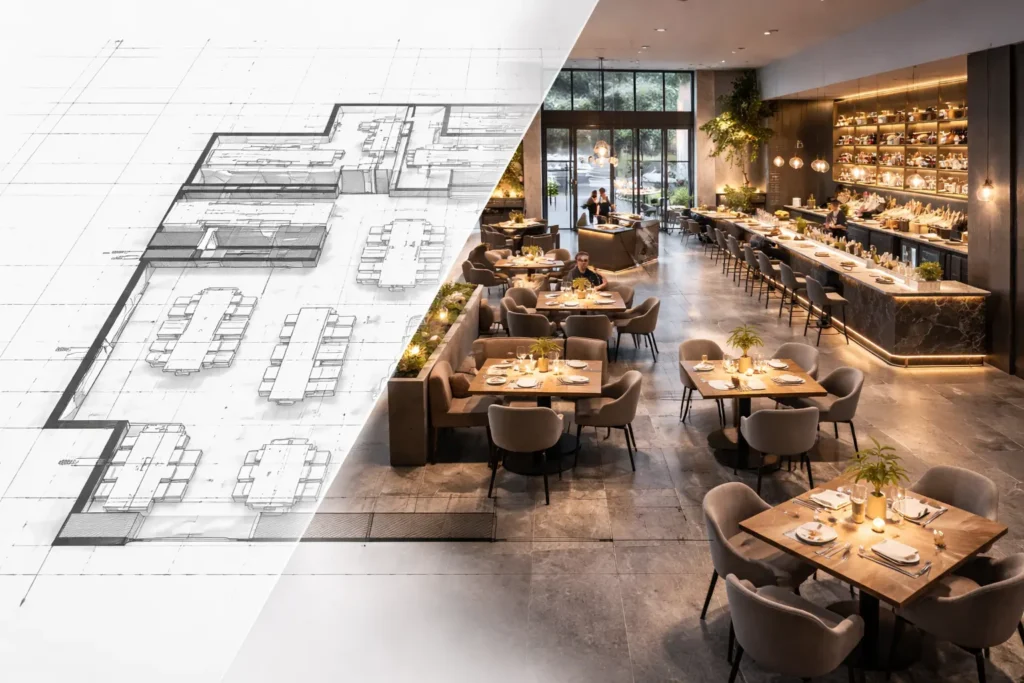
You’ve signed a lease, hired a designer, and started sketching floor plans on napkins. Then reality hits: Will 65 seats actually fit without making the room feel like a cafeteria? Can servers move between tables without turning sideways? Does the bar block the sightline to the entrance?
These aren’t hypothetical problems. They’re the kind of mistakes that can get built into concrete and drywall – and can cost tens of thousands of dollars to correct once construction is underway.
3D visualization lets you answer these questions before a single wall goes up. We build the restaurant digitally, so you can test it, break it, rearrange it, and walk through it – all inside software. What comes out is a spatially accurate, photorealistic model of your restaurant that functions as both a decision-making tool and a communication device.
This guide covers how the process works, what it catches that floor plans miss, and how to use it to make better decisions faster.
Why Is Restaurant Layout Planning Critical Before Opening?
A restaurant layout isn’t decoration. From our perspective, it’s something that must be tested visually before it becomes operational infrastructure. The placement of every wall, counter, table, and service station determines how efficiently your staff works, how comfortably your guests eat, and how much revenue the room can generate per square foot.
So what is a restaurant layout, really? It’s the spatial relationship between every element in the space – kitchen, dining room, bar, host stand, restrooms, storage, and circulation paths. Get it right, and the room feels effortless. Get it wrong, and you’ll feel it in slower table turns, awkward service flow, noise complaints, and guests who don’t come back.
The problem is that traditional planning tools – 2D floor plans and elevation drawings – are abstractions. They communicate dimensions but not experience. A floor plan can tell you a table is 30 inches from the wall. It can’t tell you whether that feels cramped when someone’s sitting there with a winter coat on the back of their chair.
This is where pre-opening restaurant design validation through 3D visualization changes the equation. You’re not guessing how the space will feel. You’re seeing it – rendered with accurate lighting, materials, furniture scale, and sightlines – before construction begins.
The financial stakes are real. A 2,500-square-foot space could represent roughly $375,000 to $1.9 million in construction costs, depending on finish level and market. Finding layout issues in a digital model is typically faster and cheaper than correcting them on-site, where changes can trigger delays and costly change orders.
Key Elements That Can Be Simulated with 3D Visualization
A well-built 3D model doesn’t just show you what the restaurant looks like. It lets you test how it works. Here’s what you can simulate before committing to construction.
Traffic flow and circulation. Staff and guest movement paths are the invisible architecture of any restaurant. A 3D layout model lets you trace server routes from kitchen to table, check for bottlenecks at the host stand, and verify that emergency egress paths meet code. You can watch – virtually – what happens when every seat is full, and three servers are running food simultaneously.
Furniture scale and proportion. Renderings built with accurate furniture dimensions reveal proportion problems that floor plans hide. A banquette that looks fine on paper might visually overwhelm a low-ceilinged room. A communal table that fits dimensionally might block the visual flow from the entrance to the back wall.
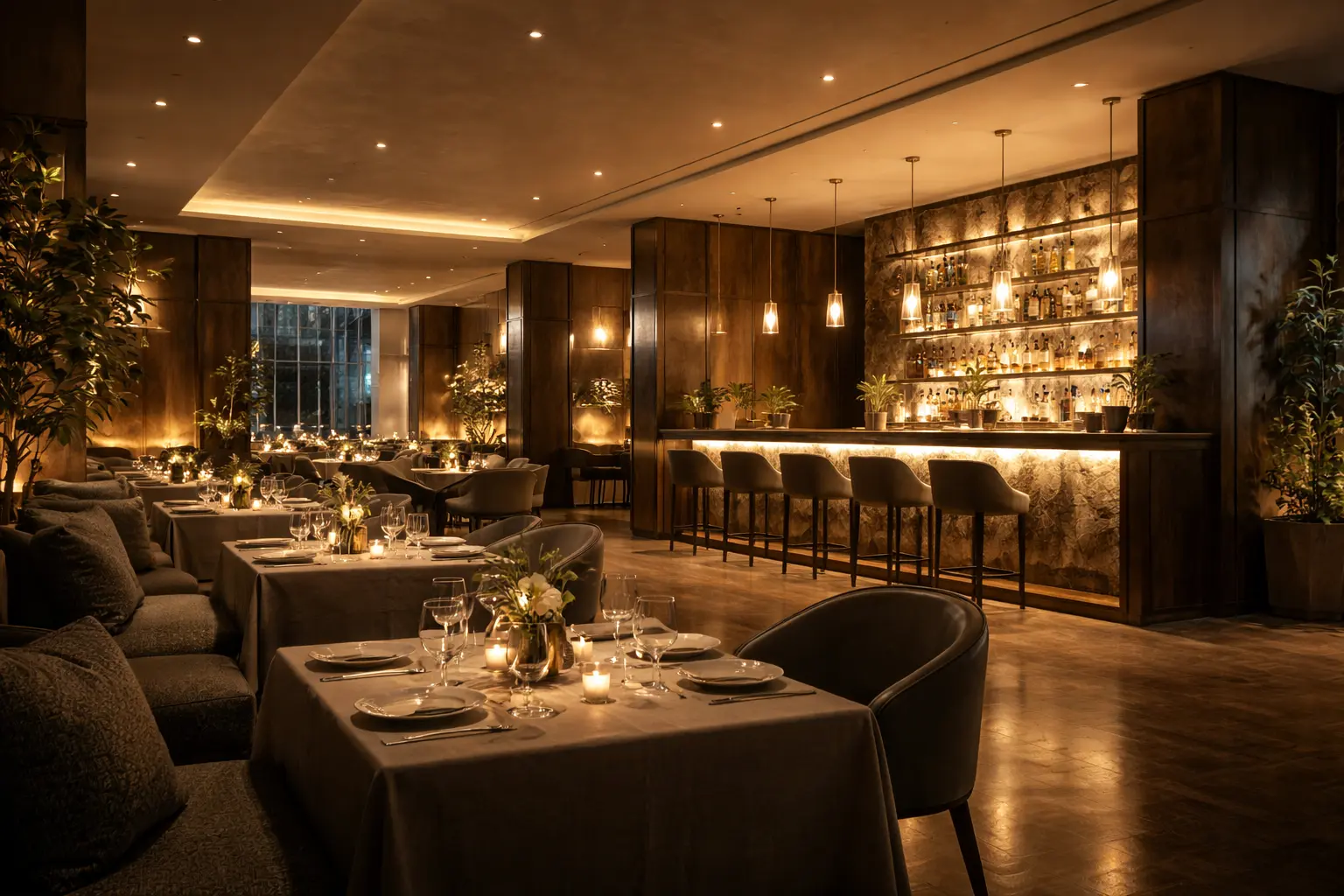
Lighting conditions. Lighting simulation shows how natural and artificial light interact with your surfaces at different times of day. That south-facing window wall might create beautiful morning light and unbearable afternoon glare. A rendering can show you both scenarios before you commit to your window treatment budget.
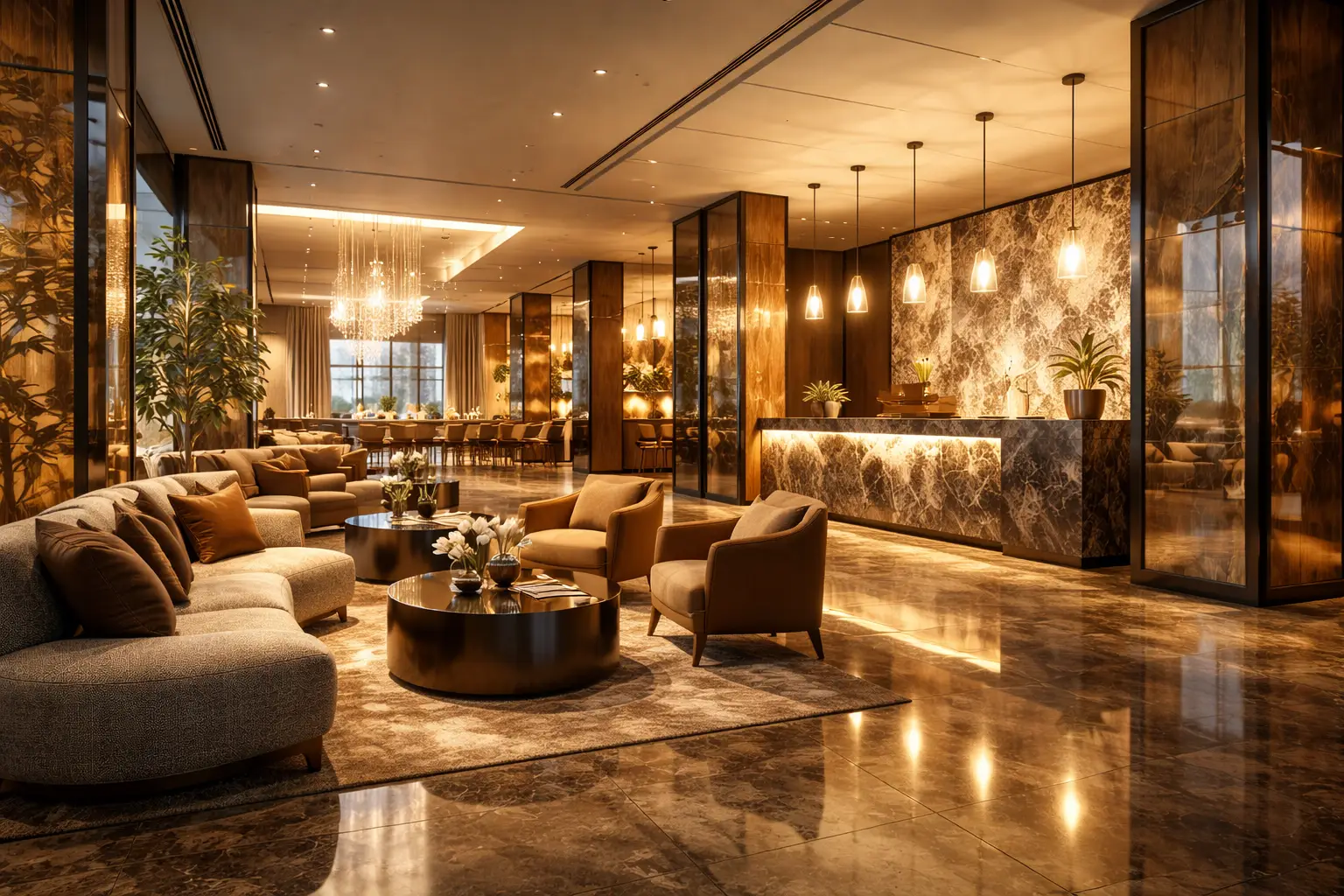
Material and finish relationships. How do your chosen textures – reclaimed wood, polished concrete, brass hardware, leather upholstery – actually look together in the space? Swatches on a mood board tell you very little. A photorealistic rendering with accurate material properties tells you almost everything.
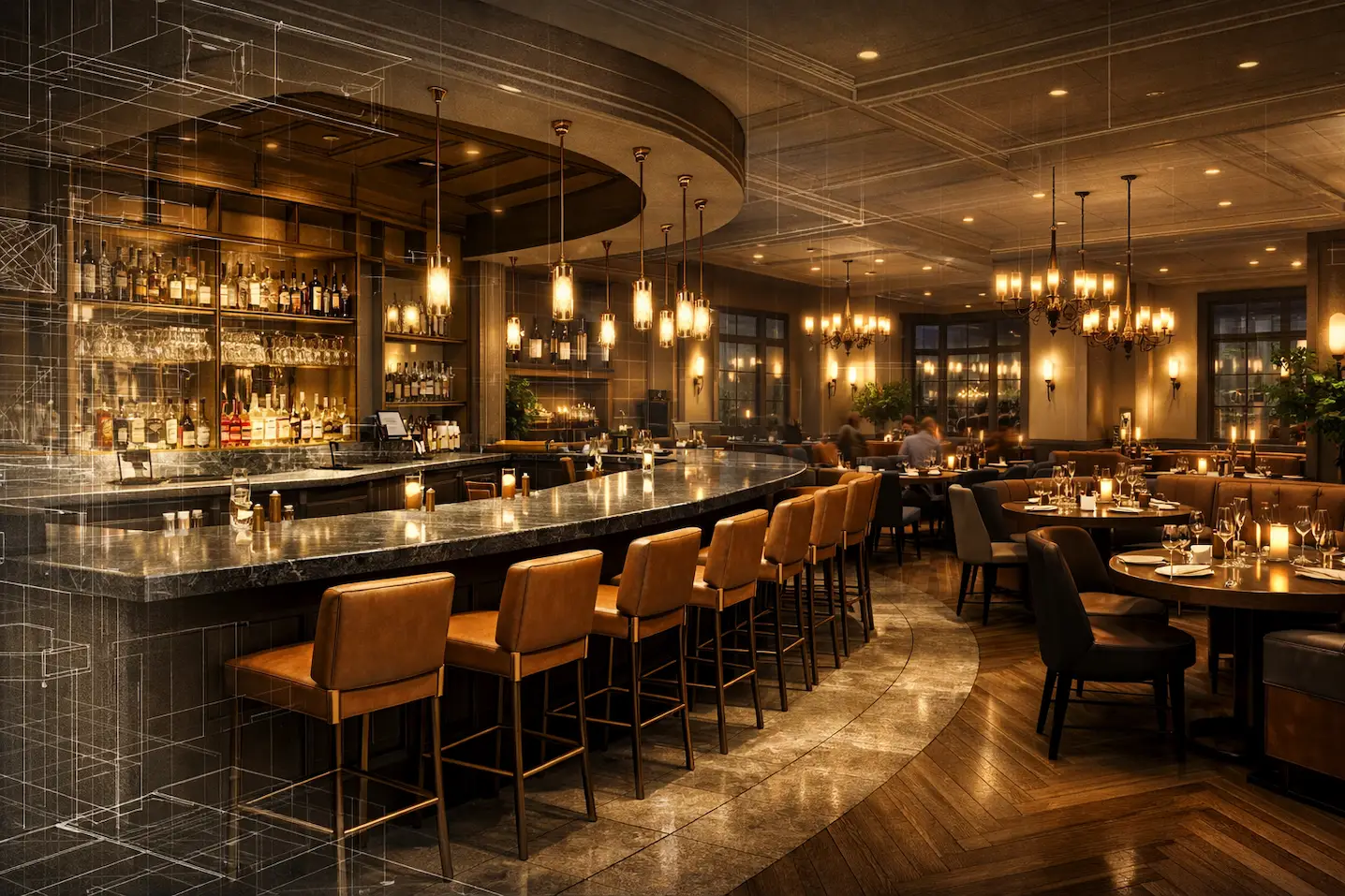
Bar configuration. Restaurant bar layout ideas are notoriously difficult to evaluate on paper because bars involve complex spatial relationships – the bartender’s reach, under-counter storage access, guest seating depth, and the visual impact of the back bar. A 3D build lets you test configurations that would take weeks to mock up physically.
How Does 3D Rendering Support Restaurant Concept Development?
Concept development is where most restaurant projects are at their most fragile. You have a vision – maybe it’s a modern izakaya with a 12-seat omakase counter, or a neighborhood bistro with a garden patio – but translating that vision into spatial reality involves hundreds of decisions that interact with each other in ways that aren’t obvious until you see them.
Restaurant rendering bridges the gap between concept and construction. It gives you a visual proof-of-concept that you can evaluate, critique, and refine before any money moves toward physical work.
Here’s an illustrative scenario we often see: a 3,200-square-foot fast-casual concept designed around a central open kitchen. The 2D plan looked great – clean geometry, efficient circulation. But when we built the 3D model, two problems became immediately visible. First, the hood system required for the cooking line dropped the ceiling height over the dining area nearest the kitchen to 8 feet, creating a claustrophobic zone that seated 14 people. Second, the kitchen’s stainless steel surfaces bounced so much light that the carefully planned moody interior atmosphere disappeared within a 10-foot radius of the pass.
Both issues were identified in the model. The design team adjusted the seating plan, and a wood-and-glass partition was introduced to manage light bleed — all before construction. Solving them on-site would have meant change orders, schedule delays, and compromised decor.
The detail that 3D visuals capture is what makes this possible. You’re not looking at a sketch or a diagram. You’re looking at a spatially accurate, materially correct representation of the room you’re about to spend six or seven figures building.
Optimizing Seating Capacity and Comfort Through Spatial Simulation
Restaurant layout dimensions aren’t just about minimums – they’re about the experience those dimensions create. A 36-inch aisle may meet minimum accessibility requirements. A 42-inch aisle feels comfortable. A 48-inch aisle feels generous. The difference between “compliant” and “comfortable” is often the difference between a restaurant that fills once and one that fills repeatedly.
In our workflow, we populate the model with accurately scaled furniture, allowing you to test real-world scenarios. What happens when you add four two-tops along the window wall? The floor plan says they fit. The 3D model shows that guests at those tables will have their chairs bumped every time someone walks to the restroom.
Through spatial simulation, you can test restaurant 3D layout options rapidly – shifting tables, swapping booth configurations for freestanding seating, adjusting bar stool spacing – and see the impact on both capacity and comfort in minutes rather than weeks.
How Does 3D Visualization Improve Collaboration Between Stakeholders?
A restaurant project involves owners, architects, interior designers, kitchen consultants, contractors, and often investors. Each stakeholder reads spatial information differently. An architect thinks in plans and sections. An owner thinks in terms of guest experience. An investor thinks in terms of returns.
3D visualization gives everyone a common language. When you’re reviewing a photorealistic rendering of the dining room, there’s no ambiguity about what’s being discussed. The owner can see whether the restaurant’s layout matches their concept. The architect can verify spatial relationships. The investor can understand what their money is building.
This shared understanding dramatically reduces the revision cycles that plague restaurant projects. Pre-opening restaurant layout validation through 3D review sessions catches misalignments early – before they become change orders.
A practical workflow looks like this: the design team produces initial renderings, stakeholders review and annotate. Revisions can often be implemented in the model more quickly than equivalent on-site changes. Iterative review cycles often help resolve the major spatial and aesthetic questions earlier, before they turn into on-site changes. Compare that to the traditional process, where misunderstandings surface during construction and get resolved through expensive on-site improvisation.
Restaurant layout testing through collaborative 3D review also builds consensus. When five stakeholders are looking at the same rendering and agreeing that the space works, you move into construction with confidence rather than lingering doubt.
FAQ
Yes. Once the base model of the space is built, rearranging furniture, swapping configurations, and testing alternative restaurant layout options takes hours, not days. Once a base model is built, you can test multiple layout variations relatively quickly, depending on scope and level of detail.
Timelines vary by scope and inputs, but many restaurant visualization packages land in a range of roughly 1–6+ weeks, especially once review rounds are included. Having architectural drawings and material selections ready at kickoff shortens the timeline significantly.
Often more useful, not less. In a small space, every inch matters more. A visualization restaurant model for a 900-square-foot café reveals spatial conflicts that are invisible on a floor plan – and in a tight space, there's less room to absorb mistakes during construction.
At minimum: architectural floor plans with dimensions (PDF or CAD), ceiling height information, and reference images for the intended style and mood. Ideally: material and finish selections, furniture specifications with dimensions, lighting fixture selections, and any existing MEP (mechanical, electrical, plumbing) drawings. The more complete the brief, the more accurate the first round of renderings.
Absolutely. Photorealistic renderings and animated walkthroughs communicate a restaurant concept far more effectively than mood boards and floor plans. Investors who can see the finished space – with accurate materials, lighting, and spatial relationships – make faster, more confident decisions. Some restaurant teams report that high-quality visual presentations help clarify their concept for investors during fundraising discussions.
No. It complements it. Architectural drawings remain the legal and technical documents that govern construction. 3D visualization translates those documents into experiential understanding – showing what the architecture will feel like, not just what it measures. The two work together: architecture defines the structure, visualization validates the experience.
Rate article:
Nice
Average rating: 5 / 5
Vote count: 1
Denys Borozenets
CEO at GENENSE
Denys is the CEO of GENENSE Studio. His mission is to build an international community of passionate CGI professionals, where everyone can unlock their potential by creating high-end digital content that helps highlight any product on the global stage.
As a leader, he holds himself to the highest standard of responsibility - for both his own work and that of his team. For the members of GENENSE, responsiveness and open communication are the core values that drive their collective success.
Smart lighting choices shape how a dining room feels, reads, and performs across the day. The question is less about a single fixture or dimmer and more about how multiple layers of light interact with materials, textures, seating, and service choreography. Photorealistic CGI makes those interactions visible before any equipment is purchased or installed. With […]
Why visualization matters in investor and franchise conversations Early restaurant decisions are commercial decisions first. Investors and franchisors review a concept through the lens of risk, brand integrity, and operational throughput. In these discussions, drawings provide the facts, but pictures carry the argument. High-quality restaurant rendering places the capital plan, site constraints, and brand narrative […]
Architects, designers, and developers rely on visualization to align project stakeholders, validate design intent, and communicate options to non‑technical stakeholders. Yet the production route is not one-size-fits-all. This article outlines real-time vs traditional rendering from a visualization perspective, helping clarify which type of output fits specific tasks and milestones. We focus on realistic tradeoffs that […]
Clear visuals reduce confusion in complex building projects. At key milestones, architects must answer specific questions from developers, structural engineers, façade consultants, cost managers, and planning authorities. Floor plans and sections alone may not fully convey height perception, façade rhythm, daylight conditions, or spatial flow to non-technical audiences. This is where 3D visualization in architecture […]
3D product animation is the process of creating a computer-generated video that shows an item in motion – rotating, assembling, disassembling, functioning, or existing within a styled environment – using three-dimensional digital models rather than a physical camera. The product doesn’t need to exist. The environment doesn’t need to be built. Everything happens inside software, […]
3D interior rendering is a digital image of a room that doesn’t exist yet. It looks like a professional photograph – accurate lighting, real materials, actual furniture models – but the space hasn’t been built. Or it’s about to be gutted and redesigned. A 3D artist takes your floor plans, material picks, and design direction, […]