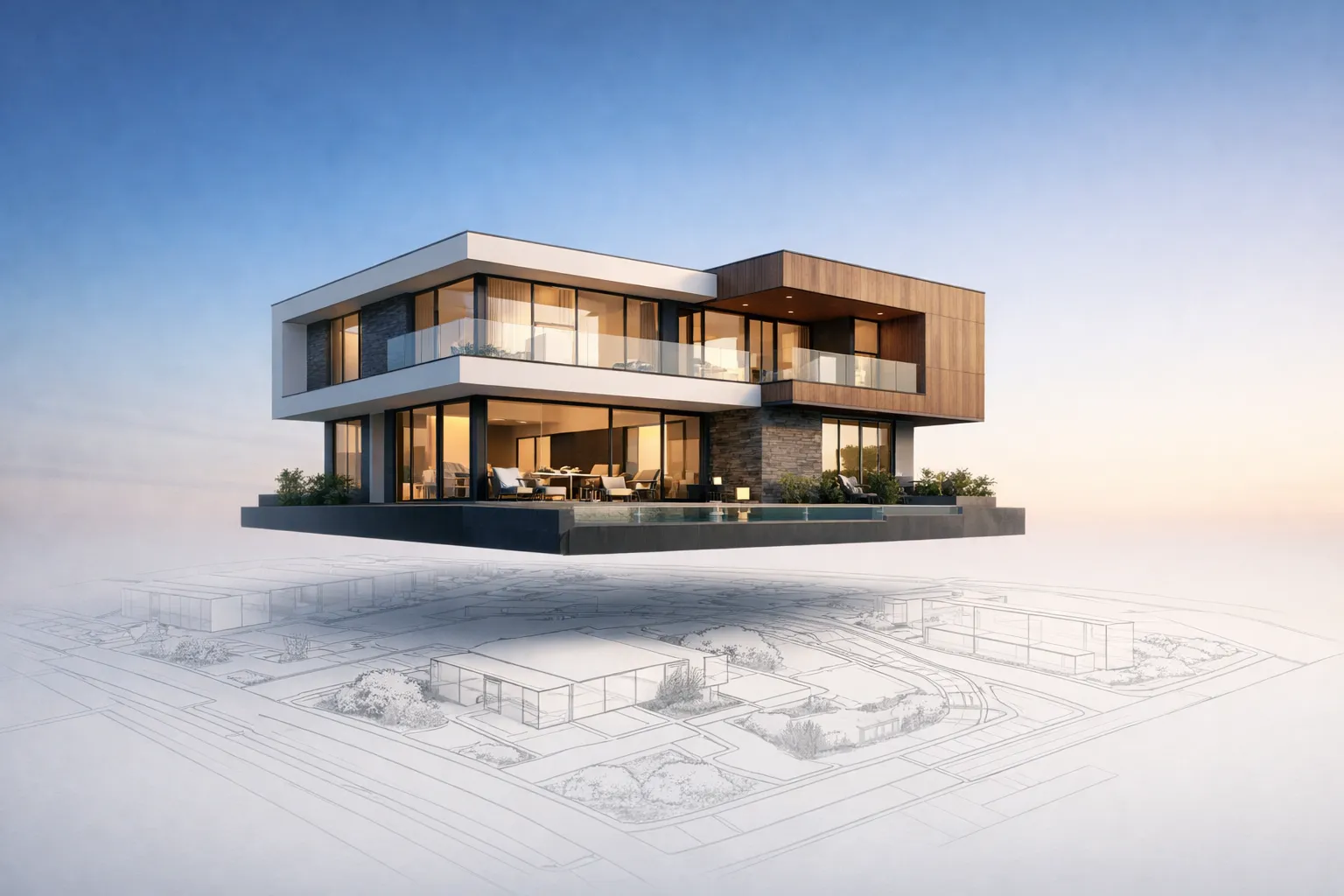
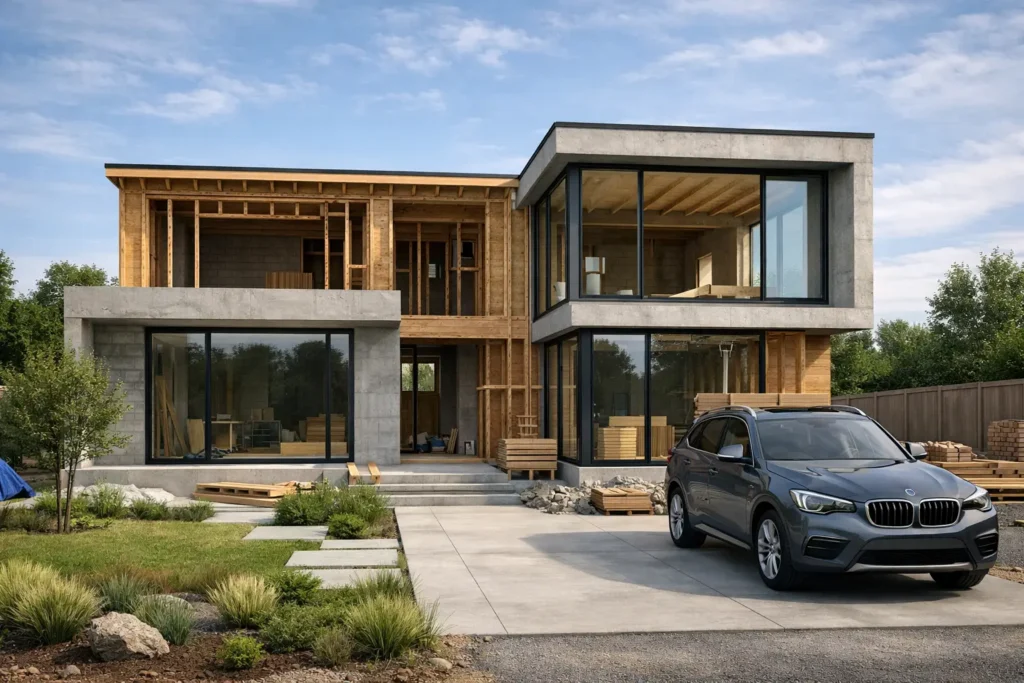
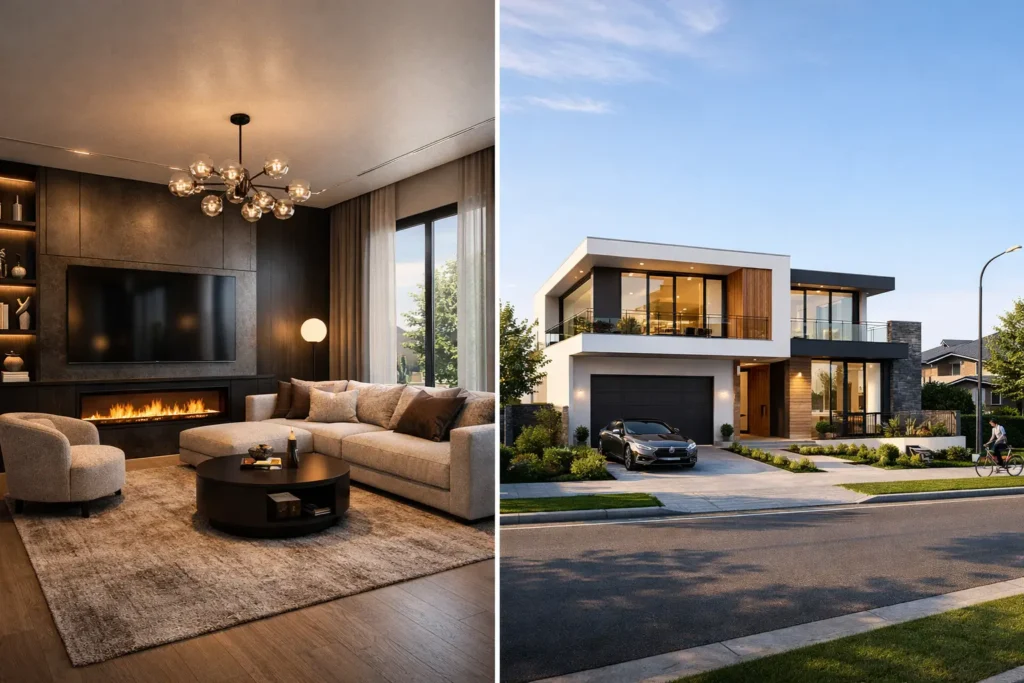
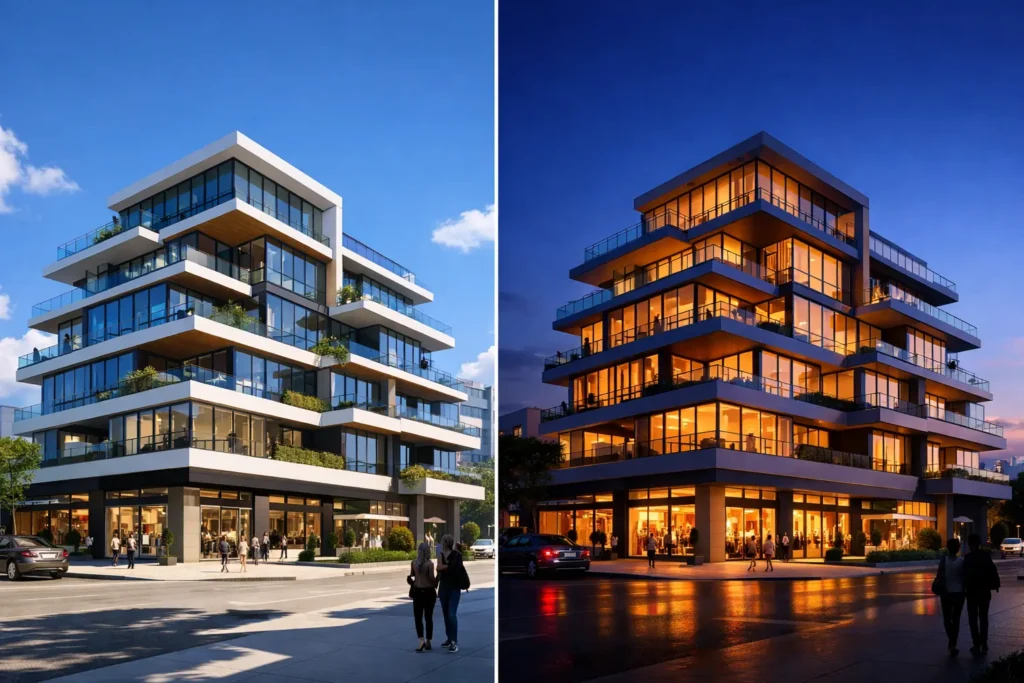
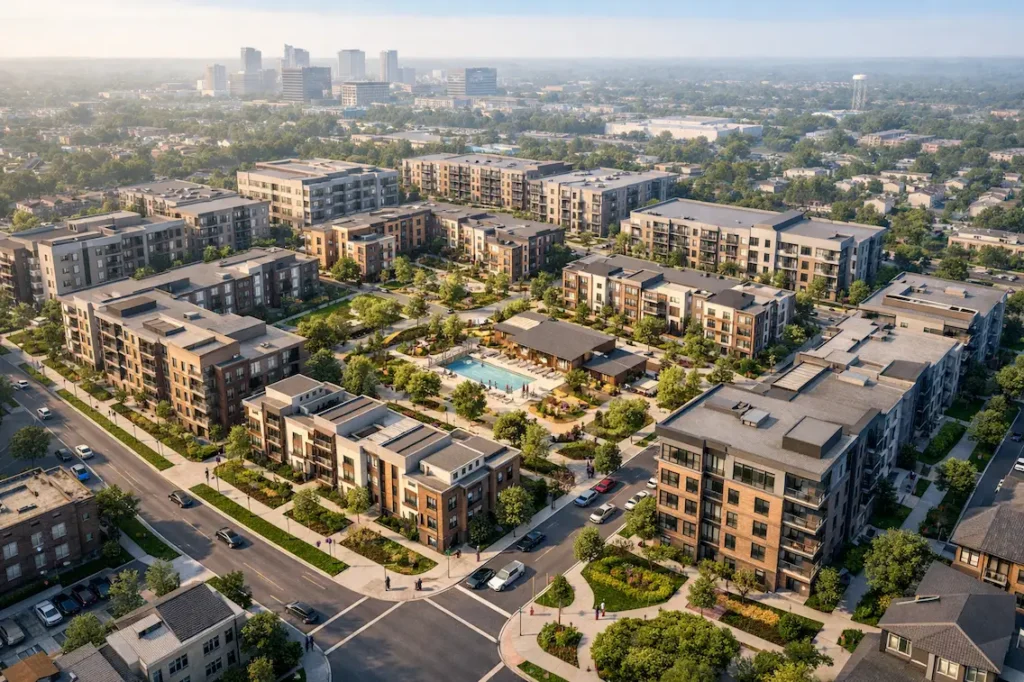
3D exterior rendering is the creation of photorealistic digital images that show what a building will look like from the outside – its facade, landscaping, surrounding streets, sky, and atmosphere – all before a single brick is laid. If you’ve ever seen a gorgeous image of a proposed development on a real estate website and wondered whether it was a photo or a computer-generated image, you were likely looking at a computer-generated exterior visualization.
We’ve spent years producing these visuals for architecture firms and developers, and one thing hasn’t changed: a great render still sells a project faster than any floor plan ever could. This guide walks you through everything you need to know – from how the process works to what it should cost, when to outsource, and how to get the most out of every image.
What Is 3D Exterior Rendering in Architecture and Real Estate?
In plain terms, it’s a digital visualization technique that turns architectural plans, CAD drawings, or BIM models into lifelike images of a building’s exterior. The output might be a single striking image of a residential facade or a full set of aerial views covering an entire master-planned community.
Think of it as taking a photograph of something that doesn’t exist yet. The render captures the building’s geometry, its materials, the way light falls across the facade at a particular time of day, the trees in the yard, the cars on the street – everything composed into one frame that instantly communicates what the finished project will feel like.
Core Components of Exterior Architectural Visualization
Every exterior render we produce – and every good one you’ll see from other studios – is built on five layers:
3D geometry – the building’s form, modeled from plans or BIM data.
Materials and textures – brick, glass, timber, concrete, metal panels, each mapped to the correct surface.
Lighting – sunlight, overcast skies, dusk glow, or a combination.
Camera and composition – the viewpoint, lens choice, and framing that tell the story.
Take away any one of these, and the image falls apart. Together, they form the foundation of 3D architectural visualization as a professional discipline – and the reason it takes real skill to do well.
Differences Between Exterior and Interior Rendering
People sometimes assume exterior and interior rendering are basically the same job with a different camera angle. They’re not. The challenges are fundamentally different:
Factor
Interior Rendering
Exterior Rendering
Lighting source
Mostly artificial
Mostly natural (sun, sky, weather)
Environment scope
A contained room
Open landscape, full streetscape
Material variety
Fabrics, wood, finishes
Facade systems, roofing, hardscape
Scale
Human-scale details
Building-scale + urban context
Weather/atmosphere
Rarely a factor
Often the whole mood
Exterior work means getting the sun angle right for a specific latitude and time of day. It means making the sky look convincing – not like a stock photo pasted behind the building. It means the trees need to cast the right shadows and the pavement needs to look wet if it just rained. None of that applies when you’re rendering a living room.
Key Applications in Residential and Commercial Projects
The use cases vary quite a bit depending on who’s commissioning the work:
Residential – here, you’re selling a lifestyle. Buyers want to picture themselves pulling into that driveway, sitting on that porch. The home in its setting matters more than the home alone.
Commercial – it’s about scale, brand presence, and how the building fits the business district. A corporate tenant wants to see their future headquarters in context.
Mixed-use – developers need to show how retail, residential, and public spaces work together without feeling like three separate projects glued to one site.
Public infrastructure – councils and communities need to see what a new transit station or park will actually look like in their neighborhood before they’ll support it.
In every case, the render does something drawings can’t: it makes the project real for people who don’t read blueprints.
How Does the 3D Exterior Rendering Process Work?
There are six stages to a professional exterior render. Knowing them helps you prepare better briefs, avoid unnecessary revisions, and keep your timeline on track.
Project Briefing and Technical Documentation Review
Everything starts here. Our visualization team goes through:
Here’s something we’ve learned the hard way: a clear, thorough brief can significantly reduce revision cycles. Vague briefs don’t save time – they cost it.
3D Modeling from CAD and BIM Files
The building geometry gets constructed in 3D, either by importing and cleaning up your CAD/BIM files or by modeling from scratch off 2D drawings. This stage produces the 3D exterior models – the structural skeleton that everything else hangs on.
Then comes the environment. We add neighboring properties, street furniture, vehicles, pedestrians – whatever it takes to ground the building in a setting that feels lived-in rather than dropped onto a blank canvas.
Natural and Artificial Lighting Setup
Lighting makes or breaks a render. Honestly, it’s the single biggest difference between amateur and professional work. The visualization artist sets:
Sun position based on the project’s geographic location, the date, and the time of day
Sky conditions – clear, partly cloudy, overcast, or dramatic
Artificial lighting – the warm glow visible through windows at dusk, exterior fixtures, and landscape uplighting
A midday sun gives you sharp shadows and high contrast – great for showing off facade depth. Late afternoon creates warmth and long shadows that add drama. Overcast light softens everything and puts the focus on materials rather than form. The right choice depends entirely on what story the image needs to tell.
Camera Composition and Perspective Framing
This is a design decision, not a technical afterthought – and it’s one that clients often underestimate. We think about:
Eye-level views – the pedestrian experience, perfect for streetscape context
Elevated angles – revealing roof forms, courtyards, site layout
Worm’s-eye views – emphasizing height and architectural presence
Focal length – wide-angle for context, telephoto for compression and drama
The best renders borrow from photography and cinematography: rule of thirds, leading lines, foreground interest, and depth layering. A technically perfect model with a bad camera angle is a wasted render.
Post-Production and Image Enhancement
After the rendering engine finishes computing the raw image, post-production brings it to life:
Color grading and contrast adjustment
Atmospheric effects – haze, subtle lens flare, depth of field
People, vehicles, lifestyle elements
Sky replacement or enhancement
Final sharpening and output formatting
Post-production usually takes 15–25% of total production time, but its impact on the final result is disproportionately large. It’s the difference between a render that looks “CG” and one that looks like it was shot by a photographer.
Why Is 3D Exterior Rendering Essential for Architects and Developers?
Design Validation and Visual Decision-Making
Here’s something that happens more often than architects like to admit: a facade composition that reads beautifully in elevation looks completely unbalanced in perspective. Material combinations that seemed harmonious on a sample board clash at building scale. Proportions that worked in plan feel wrong when you’re standing at street level looking up.
Architectural exterior 3D renderings can help identify design inconsistencies before documentation is finalized. They give design teams a way to test, compare, and refine options while changes are still free.
Client Communication and Stakeholder Alignment
Not every client reads architectural drawings fluently. A render translates technical intent into a visual language that anyone can understand – from a homeowner reviewing their first custom home to a board of directors evaluating a $200M development.
When everyone sees the same image, alignment happens faster.
Planning Approval and Municipal Presentations
More and more municipalities expect – or outright require – visual representations as part of planning submissions. Renders help planning committees assess:
How the building fits with its neighbors
Shadow impact on adjacent properties
Streetscape contribution and public realm quality
Height, massing, and scale relationships
A well-prepared set of exterior rendering views can genuinely accelerate approval timelines. Clear visual materials can support more efficient planning reviews compared to relying solely on technical drawings.
Investor Pitch Deck and Development Marketing Support
If you’re a developer seeking capital, renders aren’t a nice-to-have – they’re table stakes. Investor presentations need compelling visuals to communicate:
Project vision and design quality
Market positioning and target demographic
Development phasing and completion milestones
Real estate 3D exterior rendering turns a spreadsheet-driven pitch into a story that investors can actually see. And stories raise capital faster than spreadsheets.
Pre-Sales Strategy for Real Estate Projects
In competitive residential and commercial markets, pre-sales often kick off 12–18 months before completion. Renders become the primary visual asset for:
Sales brochures and project websites
Billboard and hoarding displays
Digital advertising campaigns
Sales suite presentations
Without high-quality visualization, your pre-sales marketing has no visual foundation. You’re asking buyers to commit six or seven figures based on a floor plan and a promise.
What Types of 3D Exterior Rendering Services Are Available?
Photorealistic 3D Exterior Rendering
This is the gold standard – and what most people picture when they hear “architectural rendering.” The goal is an image that’s virtually indistinguishable from a photograph: accurate materials, natural lighting, believable environment, and lifelike atmospheric conditions.
It’s the type used most often for marketing, sales, and client presentations. We’ve seen a single photorealistic hero image of a residential project drive more buyer inquiries than an entire brochure full of floor plans.
3D architectural rendering at this level typically takes 5–10 business days per image, depending on complexity.
Conceptual and Massing Visualization
Not every project needs photorealism – especially in the early stages. Exterior conceptual rendering uses simplified materials, abstracted landscaping, and clean compositions to communicate:
Building volume and massing
Site arrangement and orientation
Scale relationships with the surrounding context
Design options for side-by-side comparison
These are faster, more affordable, and perfect for feasibility studies, design competitions, and internal reviews where the conversation is still about “what” rather than “how it looks.”
Aerial and Bird’s-Eye Perspective Renderings
Aerial views reveal what ground-level images can’t: site layout, roof design, landscape planning, and the relationship between buildings and their surroundings. They’re especially valuable for:
Master-planned communities
Campus developments
Resort and hospitality projects
Urban infill sites where context is everything
360-Degree Exterior Views and Interactive Walkthroughs
Interactive formats let viewers explore the building from any angle. 360-degree panoramas can be embedded in websites or viewed through VR headsets, giving potential buyers or tenants an immersive experience that static images can’t match.
3D exterior visualization services in this category are growing fast as real estate marketing shifts toward digital-first strategies. Buyers increasingly expect to “walk around” a property online before they book a site visit.
CGI Exterior Rendering for Large-Scale Developments
Big developments – 50+ units, mixed-use complexes, urban regeneration projects – need a coordinated visual package, not a handful of one-off images. That typically includes:
Multiple building views from key vantage points
Streetscape and public realm perspectives
Aerial overviews showing phasing
Detail shots of entrance lobbies, amenity spaces, and landscape features
This is where 3D exterior design rendering services earn their keep: a complete visual toolkit that supports every stage from planning submission through final sales push.
Twilight and Atmospheric Exterior Renderings
Twilight renders – captured at the blue hour between sunset and full dark – are some of the most emotionally effective images in the business. Warm interior glow against a deep blue sky creates something aspirational, almost cinematic.
They work particularly well for:
Luxury residential marketing
Hospitality and restaurant projects
Retail and entertainment venues
Any project where the evening experience is part of the sell
What Factors Influence the Cost of 3D Exterior Rendering?
Pricing swings widely – from a few hundred dollars for a straightforward residential view to several thousand for a complex commercial hero shot. Here’s what actually moves the needle.
Project Scale and Architectural Complexity
A single-family home with a straightforward facade is simply faster to model and render than a 40-story tower with a parametric curtain wall. More geometry, more detail, more time.
Level of Detail and Material Realism
A conceptual massing study with white materials and minimal texturing costs a fraction of a fully detailed photorealistic render with custom material scans, weathering effects, and micro-surface detail. You’re paying for the hours it takes to make every surface convincing.
Landscaping and Surrounding Context Requirements
Lush, mature landscaping with species-specific planting, water features, and detailed hardscape adds real production time. Same goes for modeling a full urban streetscape versus placing the building on a simplified site.
Number of Views and Camera Angles
Most studios offer volume pricing, and for good reason – once the 3D model and materials are built, additional camera angles are incremental work. Pricing structures often offer lower per-image rates when multiple views are commissioned within the same project.
Revision Rounds and Design Iterations
Standard packages typically include 2–3 revision rounds. Extra rounds add cost. The most efficient approach: gather consolidated feedback from all stakeholders in each round rather than sending five separate emails over three days.
Delivery Deadlines and Production Timelines
Rush delivery often involves an additional fee, depending on the studio’s pricing policy. The easiest way to avoid this? Build visualization into your project schedule from the start, not as an afterthought two weeks before the planning submission.
When Should Architects Outsource 3D Exterior Rendering?
In-House Production Versus External Rendering Studio
Some firms keep visualization in-house. Others outsource everything. The right answer depends on your situation:
Factor
In-House
Outsourced
Cost structure
Fixed (salaries, software, hardware)
Variable (per-project)
Quality ceiling
Limited by your team’s skill level
Access to specialist talent
Scalability
Constrained by headcount
Flexible capacity on demand
Turnaround
Competing with other internal priorities
Dedicated production pipeline
For many small-to-mid-size firms, outsourcing can provide access to higher specialization without maintaining a full in-house team. You’re not carrying overhead between projects.
Efficiency Gains in Large or Fast-Track Projects
When a project demands 10+ renders across multiple phases, an external studio with dedicated capacity can deliver faster than an in-house team that’s also juggling other responsibilities. Scaled architectural rendering services can significantly reduce production bottlenecks.
Access to Specialized Visualization Expertise
Exterior rendering is a genuine specialization. The best studios employ artists who understand architecture, photography, lighting design, and post-production at a professional level. That combination of skills is difficult and expensive to build internally – and even harder to keep busy year-round.
Quality Control and Portfolio Consistency
A dedicated rendering partner learns your firm’s design language, your preferred aesthetic, and your quality threshold. Over time, that familiarity produces consistency across your portfolio that rotating freelancers can’t replicate – and consistency is what makes a body of work look intentional rather than accidental.
Long-Term Collaboration with a 3D Rendering Partner
The most productive architect-renderer relationships we’ve been part of are ongoing partnerships, not one-off jobs. A studio that already knows your work can anticipate what you need, cut briefing time dramatically, and land closer to the target on the first draft. That saves everyone time and money.
What Are the Common Challenges in Exterior Architectural Rendering?
Achieving Realistic Lighting and Shadow Behavior
We mentioned this earlier, but it bears repeating: lighting is the single biggest factor separating good renders from bad ones. The most common mistakes:
Shadows that are too sharp or too soft for the sky condition shown
Sun angles that don’t match the stated time and geographic location
Flat, even lighting that kills all sense of depth and dimension
Over-saturated or unrealistic sky colors that scream “CGI”
Getting this right requires studying real-world photography – not just tweaking sliders in a render engine.
Accurate Material Representation and Scale Consistency
A brick texture that looks perfect on a sample wall can appear tiled and repetitive when applied to a full four-story facade. Scale, natural variation, mortar depth, weathering patterns – all of these need attention. The same goes for stone, timber cladding, and metal panels. Materials that don’t read correctly at the building scale undermine the entire image.
Integration of Landscape Design and Urban Context
Dropping a building onto a flat green plane with a few generic trees doesn’t constitute context. Convincing exterior renders require:
Accurate terrain modeling that reflects the actual site
Species-appropriate vegetation for the climate and region
Realistic street and sidewalk detailing
Neighboring buildings that match real site conditions
This is often where cheaper studios cut corners – and where the difference shows most.
Managing Reflections, Glass, and Complex Surfaces
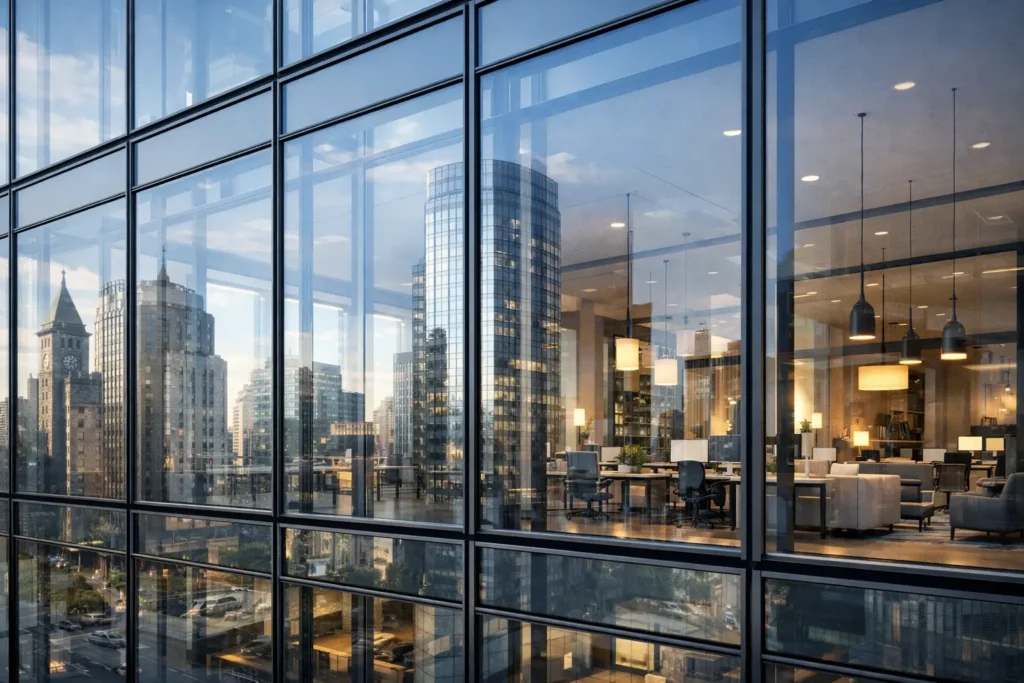
Glass facades are notoriously tricky. The balance between reflection, transparency, and visible interior is a constant calibration exercise. Too reflective, and the building looks like a mirror. Not reflective enough, and the glass looks like a hole. Getting it right – especially with curved or angled glazing – takes experience and patience.
Avoiding Over-Processing and Artificial Effects
Heavy post-production is one of the fastest ways to destroy a render’s credibility. Excessive lens flare, cranked-up saturation, unrealistic depth of field, chromatic aberration dialed to maximum – these effects don’t make an image look more real. They make it look more fake.
The best renders look effortless. Restraint is genuinely a skill.
How Is 3D Exterior Rendering Used Across Different Industries?
Residential Architecture and Private Housing
From starter homes to luxury estates, exterior house rendering helps owners see their future property before ground is broken. It’s just as useful for spec builders who need marketing material months before the model home is ready for photos.
Commercial Real Estate and Office Developments
Hotels, resorts, and mixed-use schemes use visualization to sell atmosphere and experience. A render of a beachfront resort at golden hour isn’t really about the building – it’s about the feeling. And feelings close deals that spec sheets can’t.
Hospitality and Mixed-Use Projects
Hotels, resorts, and mixed-use schemes use visualization to sell atmosphere and experience. A render of a beachfront resort at golden hour isn’t really about the building – it’s about the feeling. And feelings close deals that spec sheets can’t.
Urban Planning and Public Infrastructure
City planners and public agencies use 3D architectural exterior rendering to engage communities in the design process. Visualizing a new transit hub or public park in its actual neighborhood context helps residents understand proposed changes – and, ideally, support them.
Industrial and Logistics Facilities
Even warehouses and distribution centers benefit from exterior visualization, particularly when seeking planning approval in sensitive locations or communicating design quality to corporate clients who care about their brand’s physical presence.
How Is Technology Transforming 3D Exterior Rendering?
Real-Time Rendering Engines and Interactive Visualization
Engines like Unreal Engine 5 and Twinmotion now produce near-photorealistic quality in real time. That means architects can explore design options interactively during client meetings – rotating the building, swapping materials, changing the time of day – all live, all instant. Five years ago, achieving this level of real-time photorealism was far less accessible outside specialized environments.
AI-Assisted Rendering Workflows
AI is speeding up several stages of the pipeline:
Denoising – AI-powered denoising can significantly reduce render times in many workflows
Sky and environment generation – creating realistic backgrounds from text prompts
Upscaling – enhancing resolution without re-rendering from scratch
Style transfer – applying photographic looks to raw renders
To be clear: AI doesn’t replace the artist. It removes the tedious parts and compresses timelines. The creative decisions – composition, mood, storytelling – still require a human eye.
Integration with Drone Photography and Site Scans
Drone-captured site photography and LiDAR scans provide accurate existing-condition data that can be integrated directly into 3D renders. This means the proposed building sits convincingly within its real-world context – not an approximation of it, but the actual site as it exists today.
Cloud Collaboration and Remote Review Tools
Cloud-based platforms now allow architects, developers, and visualization teams to review renders collaboratively in real time – annotating images, comparing options, approving deliverables – without the email chains and WeTransfer links that used to slow everything down.
Emerging Trends in Exterior Architectural Visualization
A few developments worth watching:
Neural radiance fields (NeRF) for photogrammetry-based context modeling
Generative AI for rapid concept exploration and mood boarding
WebGL and browser-based 3D for interactive project websites
Digital twins linking rendered visuals to live building performance data
Sustainability visualization – showing green roofs, solar arrays, and energy performance overlays as standard deliverables
How Can Designers Achieve Better Results from a 3D Exterior Rendering Project?
Preparing Accurate Technical Documentation
The quality of the render is directly proportional to the quality of the input. Full stop. Provide:
Finalized floor plans, elevations, and sections (DWG or RVT preferred)
Material specifications with product references or sample images
Site plan with north orientation and neighboring context
Reference images showing the mood, lighting, and atmosphere you’re after
Incomplete documentation is the number one cause of delays and unnecessary revisions. We see it on nearly every project where the brief was rushed.
Structuring Feedback and Revision Cycles
Good feedback is:
Consolidated – one round of comments from everyone who has a say, not five emails arriving over a week
Specific – “the brick should be warmer, closer to this reference” beats “something feels off” by a mile
Prioritized – separate the critical changes from the nice-to-haves
Visual – mark up the image directly whenever possible
Bad feedback costs everyone time and money. It’s worth spending 20 minutes organizing your comments before sending them.
Aligning Visualization with Brand and Marketing Strategy
Renders don’t exist in a vacuum. They’re part of a broader marketing ecosystem, and your visualization partner needs to understand:
Brand guidelines – color palette, typography, tone of voice
A render that looks stunning on screen but falls apart when printed at billboard scale is a render that wasn’t briefed properly.
Selecting the Right Deliverables for Different Project Phases
Not every phase needs the same level of visualization. Spending $5,000 on a photorealistic hero image during feasibility is premature. Submitting a massing study for your marketing launch is underwhelming. Match the deliverable to the moment:
Project Phase
Recommended Deliverable
Feasibility
Massing study, conceptual views
Design development
Draft renders, material studies
Planning submission
Photorealistic context views
Marketing launch
Hero images, aerial views, twilight renders
Sales phase
Full render package, 360° views, animation
Measuring the ROI of Exterior Architectural Rendering
Visualization is an investment, not a line item to minimize. If you want to justify the spend, track these:
Pre-sales velocity – how quickly units move after marketing launch
Planning approval rate – percentage of submissions approved on first review
Client conversion – how often prospects become paying clients after seeing renders
Design efficiency – reduction in change orders attributed to early visualization
Some firms report strong returns on visualization investments when tracking metrics such as pre-sales velocity and approval rates. The ones that don’t measure it tend to see rendering as a cost – and they underinvest accordingly.
FAQ
3D modeling is building the digital geometry – the shape and structure of the building in three-dimensional space. Rendering is what happens next: applying materials, lighting, environment, and camera settings to produce a finished image. One way to think about it – modeling is building the set, rendering is taking the photograph.
At the professional level, photorealistic renders are virtually indistinguishable from photographs. We're talking physically accurate lighting engines, high-resolution material scans, and skilled post-production that adds the kind of subtle imperfections – weathering, dust, uneven wear – that make a scene feel real rather than sterile.
Most 3D exterior rendering services include 2–3 revision rounds as standard. The first round tackles major changes – camera angle, lighting direction, and material swaps. The second handles refinements – color adjustments, landscaping tweaks, and people placement. A third round is for final polish. Additional rounds are usually available at an hourly or per-round rate.
Yes – and increasingly, planning authorities expect it. Renders showing the proposed building in its streetscape context, with accurate massing and material representation, help committees make informed decisions faster. Verified views – renders calibrated to match specific real-world camera positions – carry particular weight in planning reviews and are sometimes required for sensitive sites.
It depends on the scope:
Conceptual/massing views: 2–3 business days
Standard photorealistic render: 5–7 business days
Complex hero image: 7–10 business days
Full render package (5–10 images): 2–4 weeks
These timelines assume you've provided finalized documentation. Incomplete briefs add days – sometimes weeks.
Absolutely. Renders are communication tools, not construction documents. They carry no dimensions, no structural information, no regulatory compliance data. Technical drawings remain the legal and contractual foundation for building. Renders complement them – they never replace them.
The industry workhorses:
3ds Max + V-Ray/Corona – the most widely used combination in architectural visualization
SketchUp + Enscape/V-Ray – popular for faster workflows and early-stage design exploration
Blender + Cycles – a powerful open-source option that's gaining serious professional traction
Unreal Engine 5 – leading the real-time rendering revolution
Cinema 4D + Redshift – favored by studios that value an intuitive, artist-friendly interface
Honestly, the best software is the one your team knows deeply. Quality comes from the artist, not the tool.
Without question. Even a single-family home benefits from one or two exterior views. For homeowners, it eliminates the anxiety of not knowing what their investment will look like. For architects, it reduces miscommunication and costly change orders. For builders, it gives you a marketing asset before the property exists.
A single high-quality render of an exterior house rendering project typically runs $500–$1,500 – a fraction of what a single design change costs during construction. It's one of the highest-ROI investments a small project can make.
This guide draws on our team's experience producing exterior visualization for architecture firms and developers across residential, commercial, and mixed-use sectors. Cost figures and timelines reflect industry averages as of 2025 and will vary by region, studio, and project scope.
Rate article:
Nice
Average rating: 5 / 5
Vote count: 1
Denys Borozenets
CEO at GENENSE
Denys is the CEO of GENENSE Studio. His mission is to build an international community of passionate CGI professionals, where everyone can unlock their potential by creating high-end digital content that helps highlight any product on the global stage.
As a leader, he holds himself to the highest standard of responsibility - for both his own work and that of his team. For the members of GENENSE, responsiveness and open communication are the core values that drive their collective success.
3D product animation is the process of creating a computer-generated video that shows an item in motion – rotating, assembling, disassembling, functioning, or existing within a styled environment – using three-dimensional digital models rather than a physical camera. The product doesn’t need to exist. The environment doesn’t need to be built. Everything happens inside software, […]
3D interior rendering is a digital image of a room that doesn’t exist yet. It looks like a professional photograph – accurate lighting, real materials, actual furniture models – but the space hasn’t been built. Or it’s about to be gutted and redesigned. A 3D artist takes your floor plans, material picks, and design direction, […]
A 3D walkthrough animation is a computer-generated visual simulation that allows viewers to virtually navigate a three-dimensional space as if physically moving within it. Created using specialized 3D modeling and rendering software, it presents a continuous sequence of frames that replicates the experience of moving through an architectural structure, landscape, or other designed space — […]
3D furniture rendering is the process of creating photorealistic digital images of furniture using computer-generated imagery (CGI) rather than a physical camera. A 3D artist builds a virtual replica of a piece of furniture – geometry, materials, lighting, environment – and the software calculates how light would behave across every surface, producing an image that […]
Why corporate headquarters need visualization that goes beyond “nice pictures.” Corporate headquarters are not just workplaces – they are strategic assets. Executive floors host investor briefings, R&D labs sit next to agile neighborhoods, and client areas must perform as brand touchpoints while meeting stringent acoustic, security, and wellness criteria. In this setting, office interior rendering […]
Why visualization makes or breaks a sports pitch Securing buy‑in for an arena, training complex, or campus rec upgrade demands more than attractive images. Decision‑makers need to understand how a building will move crowds, manage light and sound, and deliver revenue across game day and non‑event operations. This is where rigorous visualization turns vision into […]