In fitness projects, the most expensive mistakes rarely come from finishes. They come from moving heavy equipment after construction has started, rebalancing HVAC because the cardio area runs hot, or discovering that barbell clearances clash with a column line. High‑stakes issues often hide in plain sight on plan views. Photoreal visualization brings those decisions forward, letting project teams see the operational reality before a single bolt is drilled.
Why visualizing zones early prevents costly rework
A high-performance gym layout is not just a furniture plan. It is an operational model that balances flow, queuing, safety, staff oversight, and brand experience. When a developer, operator, and design team agree on equipment adjacencies and servicing routes early, downstream coordination accelerates and change orders shrink. Clients who visualize equipment zones in context typically reduce the number of late design iterations, protect opening dates, and preserve capex that would otherwise be consumed by rework.
In commercial gym design, the risk profile is amplified by structural loading under free‑weight areas, acoustic separation from neighbors, and the heat and noise concentrated by cardio clusters. Visualizing these constraints in parallel with aesthetic intent gives stakeholders a common language to validate choices. At GENENSE, we build that language with site‑specific CGI and motion that allow teams to test multiple options under realistic lighting, crowding, and circulation scenarios.
From program to plan: zoning that drives performance
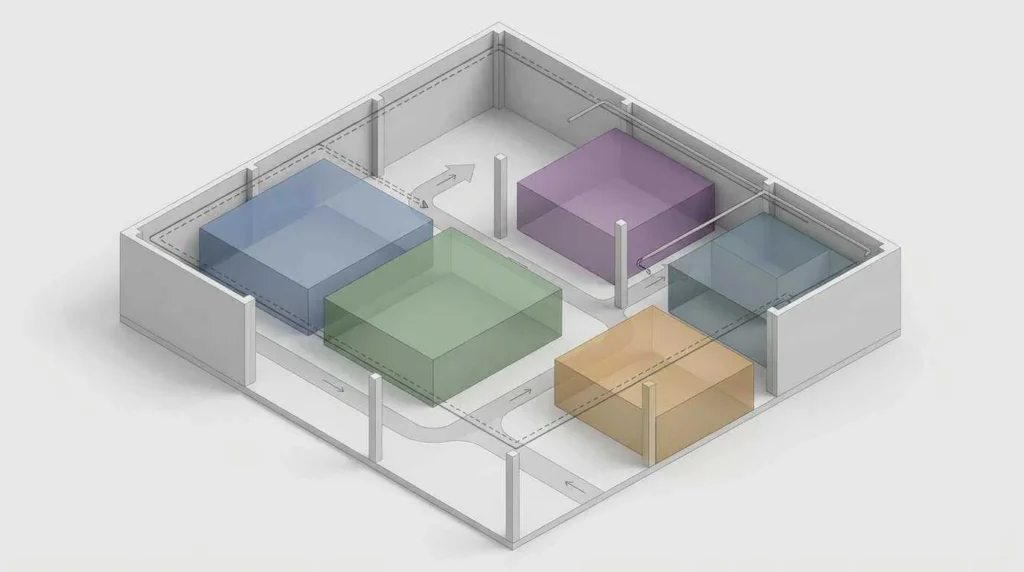
Every successful fitness environment starts with a clear program translated into zones, then layered with service routes and compliance. Teams often ask how to design a gym so the space feels intuitive on day one and resilient after months of peak‑time loading. The answer is to turn the program into sightlines, clearances, and back‑of‑house logic, then pressure‑test those decisions with renders that expose bottlenecks before they exist.
Front‑of‑house and retail
Reception must command visual control over the entry path, turnstiles, and key circulation nodes. If retail is part of the pro forma, counters and impulse displays should not constrict egress or ADA clear widths. Renders help determine how much merchandise is feasible without creating crowding during evening peaks.
Locker rooms and back‑of‑house
These areas carry the heaviest plumbing and ventilation loads. Visualizing circulation through the locker aisle, vanity zones, and shower entries reduces pool‑outs at pinch points. Back‑of‑house routes for laundry carts and deliveries should avoid intersecting member paths, especially near group class turnovers.
Cardio cluster
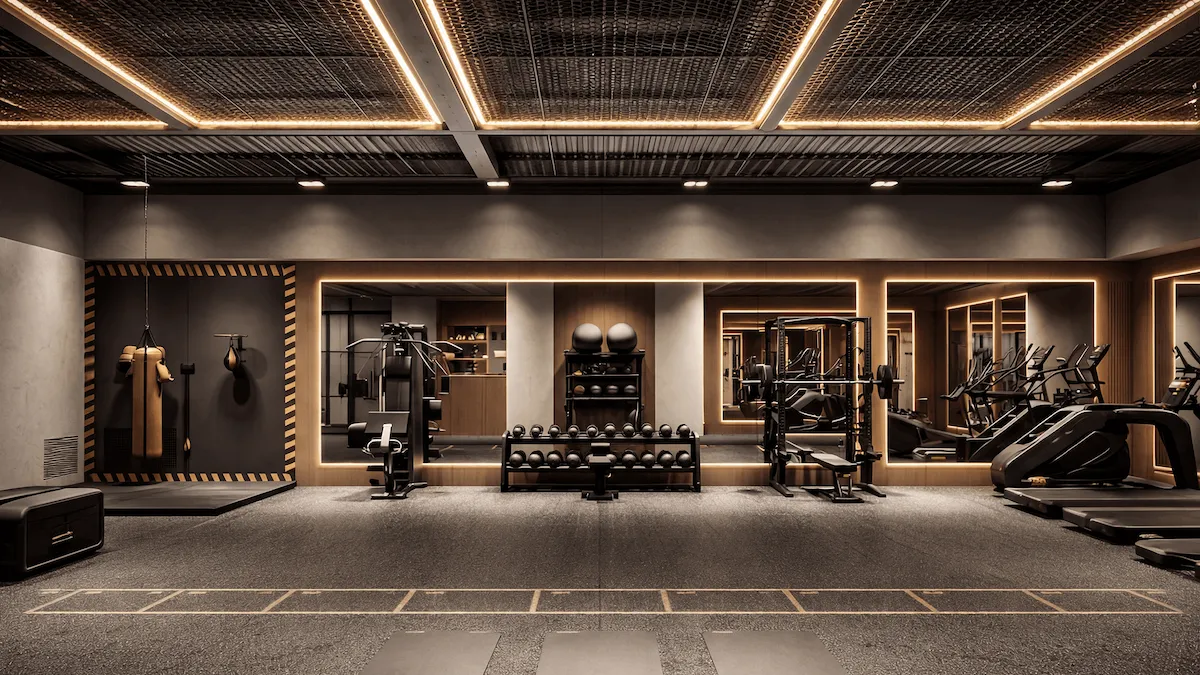
Cardio zones concentrate heat, noise, and traffic. Our cardio zone design 3D visualizations combine accurate equipment footprints with real head‑heights to verify views to media walls, glazing, or brand features. We simulate day‑night lighting to confirm comfort and glare, then stage camera paths that match how members actually approach and queue.
Strength and free weights
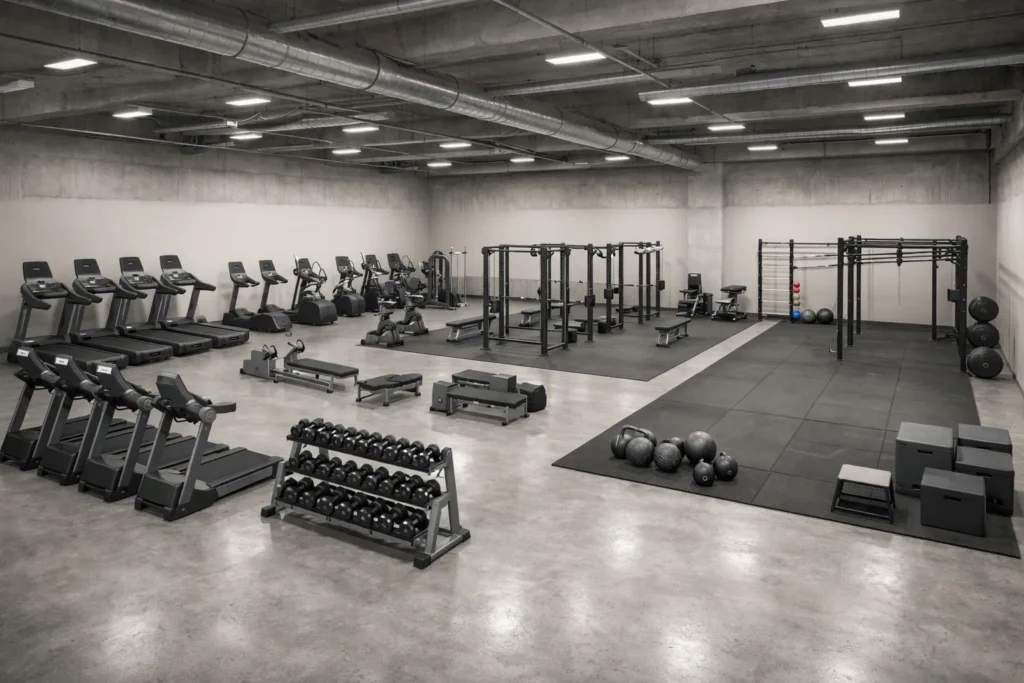
Barbell lengths, spotting space, and dumbbell pick‑up behavior challenge purely 2D planning. Photoreal CGI reveals sightline conflicts between squat racks and mirrors, highlights the depth needed behind benches, and shows where staff supervision is strongest. Structural loads and impact isolation can be overlaid to steer platforms to slab‑friendly locations.
Functional training and studio
Dynamic movement needs generous clearances and resilient surfaces. Our functional training zone 3D visualization explores rig placement, turf runs, sled turnarounds, and accessory storage so the zone stays tidy at peak use. For group classes, we validate instructor sightlines, lighting cues, and AV wall positions to keep choreography clean.
Cross‑training and high‑impact areas
Programming that includes racked lifts, rope climbs, or wall balls benefits from vertical and horizontal safety buffers. Using crossfit gym 3D rendering, we check ceiling clearances for ropes and rings, fall zones around rigs, and acoustic boundaries to protect adjacent uses like treatment rooms or coworking pods.
Baseline metrics to test in early renders
Before fit‑out, we recommend validating the following dimensions and service requirements in CGI. These are planning checks and should be confirmed against local codes and specific equipment data.
Cardio spacing: side clearances typically start from minimum industry-standard values (often around ~0.5 m) and are frequently increased to improve comfort and support emergency egress. Rear clearances behind treadmills are usually planned at approximately 6 ft or more, with final dimensions adjusted to the specific equipment configuration and applicable safety requirements.
Free weights: allow 6–8 ft from the rack face to the back of a working bench; provide at least 36 in for an accessible route behind benches, and increase this width near high-traffic or egress areas based on local codes and actual use scenarios.
Strength machines: target 3 ft lateral access for seat adjustments and safe entry, with 4 ft where swing paths or cables extend.
Functional zones: station area should be driven by the actual modality (sleds/kettlebells/rig/mobility) and peak density; set a program-based range and validate it in CGI—lower-intensity uses (stretching/mobility) are often planned at tens of sq ft per user, not a fixed 100–150.
Circulation is often planned at around 5 ft for primary spines and 3.5–4 ft for secondary routes, with final widths set by accessibility, egress requirements, and occupant load.
Ceiling heights around 10–12 ft are typically sufficient for many modalities, but must be validated against specific equipment, building systems, and local code requirements.
Acoustic and vibration: impact isolation should be specified by the chosen system (rubber layers/floating floors/inertia solutions); allow a variable build-up thickness and verify its impact on clear heights and transitions—the depth can be smaller or significantly larger depending on the assembly.
HVAC and power: cardio clusters typically present higher thermal and electrical loads due to the combined effect of equipment, occupant density, and usage patterns.
These checks flow directly into the fitness center layout, giving teams a practical yardstick while we refine materials and lighting. Because every shell is different, we verify structure and services before locking down any commercial gym floor plan.
Turning CAD into decisions with CGI
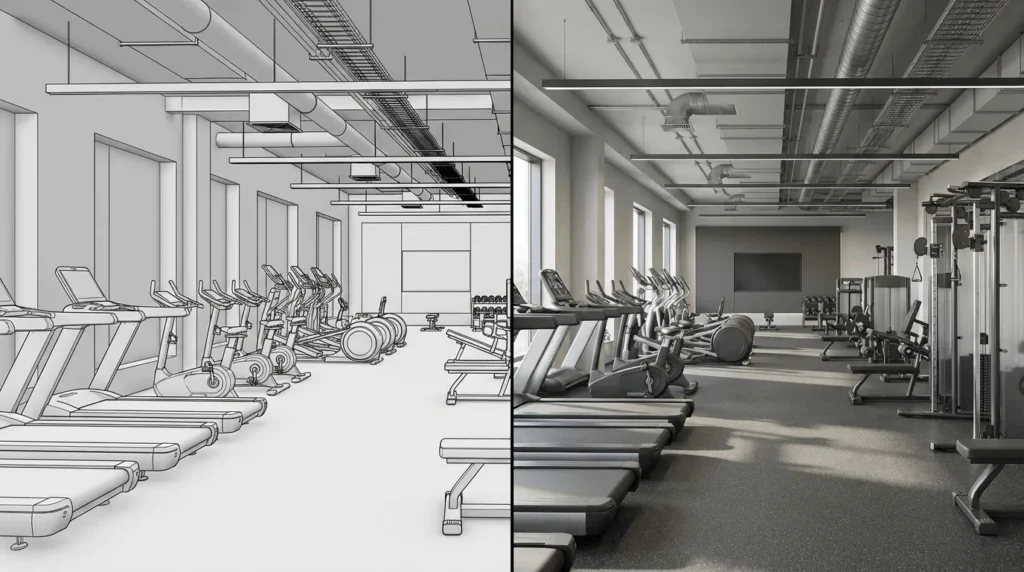
Design teams supply us with DWGs or Revit files, equipment schedules, brand guidelines, and site photos. We parse the drawings, build a clean 3D model, and place realistic equipment assets to match specified makes and models. From there, we light, texture, and choreograph the scene to show the space as members will experience it.
Photoreal fitness center CGI visualization is particularly effective for steering stakeholder debates away from opinions and toward evidence. When a landlord questions platform placement over a parking bay, or operations leaders worry about visibility from reception to the stretching area, a targeted camera set with alternative options resolves the issue in hours rather than weeks. For early creative buy‑in, we deliver fitness studio interior concept rendering packages that test brand palettes, wayfinding, and material behavior under different light temperatures.
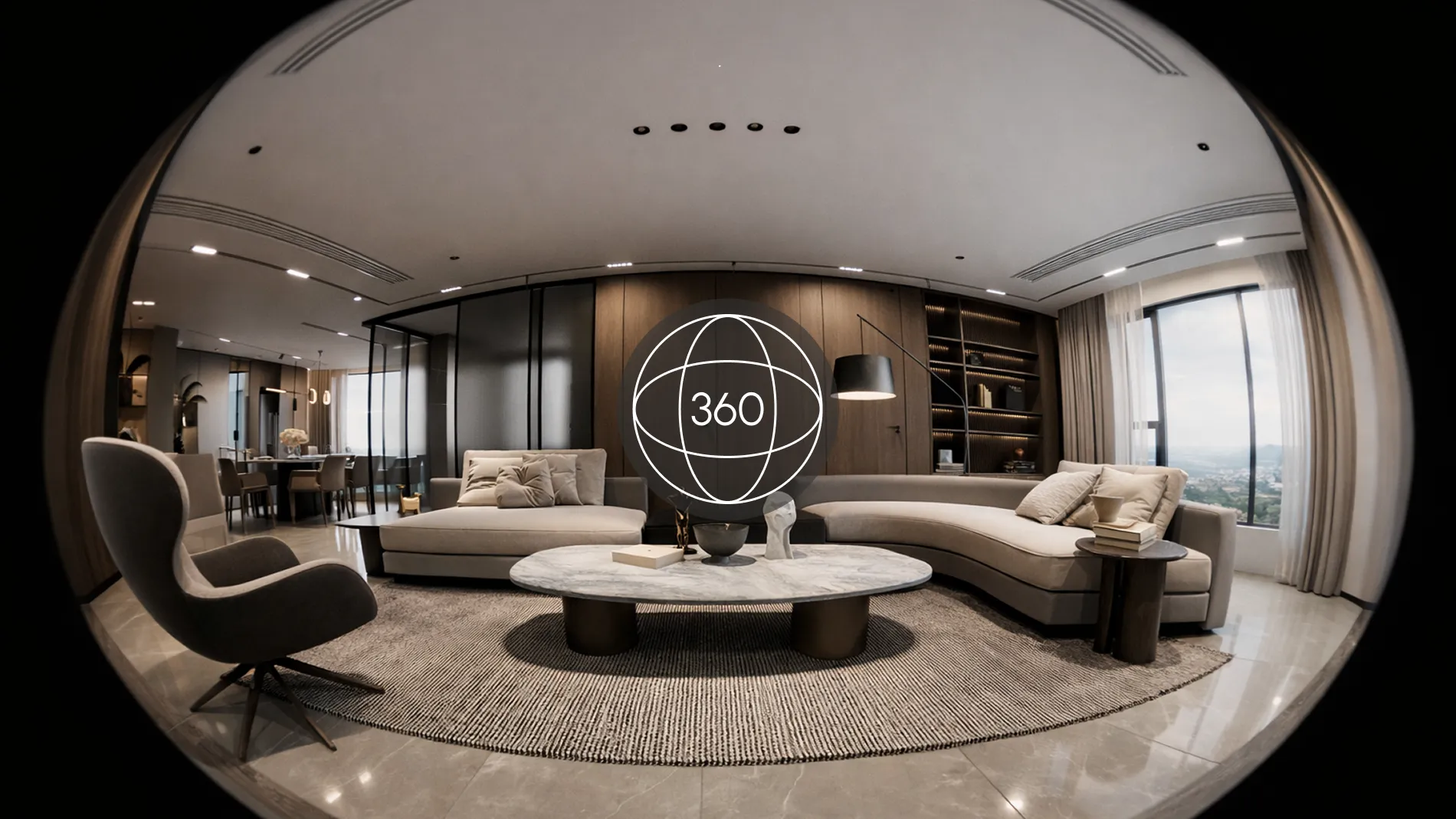
When you need a deeper dive, we produce immersive gym interior 3D visualization and short architectural animations. These sequences stress‑test circulation at changeover moments, demonstrate how signage reads from key approaches, and prove whether a glossy tile still performs under functional lighting without glare. For remote stakeholders, our 3D virtual tours carry the same visual fidelity into a navigable experience that works for board meetings and pre‑leasing presentations.
Technical constraints CGI helps de‑risk
Structural loading and impact isolation: Renders communicate where platforms, racks, and heavy selectorized machines fall relative to beams or post‑tensioned zones. Operators can then decide whether to cluster heavy equipment over supports or invest in enhanced isolation.
Acoustics and neighbor protection: High‑impact and amplified‑music areas benefit from modeled partitions, doors, and acoustic ceilings. CGI shows what these treatments look like while acoustic consultants finalize ratings and build‑ups.
Lighting quality vs. energy targets: Visualization balances brand‑bright environments with glare control on mirrors, console screens, and polished floors. We simulate warm‑up and cool‑down scenes so controls are planned at the right granularity.
Hygiene and maintainability: Surfaces look great in samples, but CGI reveals how grout lines, seams, and fixtures read at scale. We use realistic wear to caution against high‑maintenance choices in heavy‑traffic zones.
Egress and ADA: We model door swings, queuing, and clear widths to comply with local codes while preserving sightlines and product storytelling at reception or retail.
Quantifying space and flow
The most common planning gap is misjudging scale. A room that appears generous on a plan can feel tight once racks, benches, and people occupy it. Early renders force precision around gym dimensions and traffic density by showing how real bodies use space. When we test multiple camera heights and human scales, teams quickly see whether a 12‑ft bay truly accommodates a barbell lift without impinging on circulation or mirrored walls.
We also map supervision arcs from staff positions and glass lines. CGI helps confirm that coaches can monitor high‑risk activities from logical posts and that CPT zones are visible yet distinct from member‑led training.
Process, deliverables, and timeline
GENENSE supports fitness projects from concept through marketing. For planning and stakeholder alignment, teams typically commission a focused package that moves fast without sacrificing rigor.
Typical deliverables we provide to gym and studio projects:
Photoreal stills for each zone at key viewpoints, with two or three targeted alternates per decision point.
Short motion sequences to demonstrate circulation, lighting transitions, or class changeovers.
360s or lightweight interactive tours for remote reviews and pre‑sales presentations.
Annotated overlays that mark clearances, sightlines, and service points directly on the render.
Material boards and lighting studies showing day‑night behavior under the selected color temperature.
Optional photomontage of renders into site photography to test transparency, signage, and neighbor impact.
Coordinating with consultants and vendors
Renders are most powerful when they are tied into real data. We align with structural, MEP, and acoustic consultants early, then add their constraints into the CGI so visuals do not promise the impossible. Equipment vendors can supply verified CAD blocks and service clearances that we swap into the scene. This is also where operational policies enter the picture, such as floor conduct rules for dropping weights or SOPs for cleaning between sessions. When we visualize both the brand and the backbone services, approvals come faster because stakeholders can see that ambition and feasibility match.
A retail‑to‑fitness conversion scenario
Consider a 12,000 sq ft ground‑floor retail shell with three structural bays and a 14 ft clear height. The operator’s program calls for 70 pieces of cardio, a strength floor with 10 racks, a 2,000 sq ft functional zone, and two group studios. We visualize two zoning options.
Option A pulls cardio to the glazed perimeter for street theater, concentrating heat and AV at the facade but maximizing brand presence. Option B pushes strength to the perimeter so members see activity from outside, keeping cardio centralized under a larger supply air plenum. In this specific project, Option B shortens duct runs, improves supervision from reception, and reduces solar heat gain. This conclusion is driven by the particular shell and layout conditions. The landlord also prefers Option B because the acoustic risk is lower at the party wall next to residential.
Within one review cycle, the team locks the layout, updates equipment orders, and sends the MEP for coordination. The project gains two weeks on the program simply by moving debate into a shared visual language.
Integrating visualization with marketing
Once planning decisions are made, the same assets roll into pre‑sales campaigns. Camera sets that proved equipment logic become hero shots for paid media. Animated paths that explained egress turn into social cuts for trainer‑led tours. If your leasing strategy includes pre‑opening memberships, CGI provides the visual proof that convinces buyers. And because the content is grounded in the real model and equipment list, it reduces the risk of overselling features that will not survive value engineering.
Working with GENENSE
We focus on photorealistic CGI that advances design and operations, not just glossy imagery. Our studio partners with architects, operators, and developers to build predictable workflows, clear options, and decision‑ready visualizations. If you are standardizing a multi‑site portfolio or opening a flagship, we scale from quick option studies to full animation and virtual tours. Explore our 3D interior visualization, architectural animation, and 3D virtual tour services to see how we approach fitness and wellness environments.
Closing thought
If your team needs to articulate how 3D rendering helps fitness center design, an early zoning package is the most practical place to start. It turns program into evidence, aligns stakeholders, and de‑risks the fit‑out while generating assets that carry through to marketing. Schedule a short call with GENENSE to scope a decision‑ready CGI set for your next fitness project.
FAQ
We typically request base plans in DWG or Revit, a preliminary equipment schedule with makes and models, ceiling heights, and structural notes, and brand guidelines for finishes. Photos or videos of the shell help us match daylight and neighborhood context. If consultants are already engaged, their notes on acoustics, HVAC, and structure let us embed feasibility into the visuals from round one.
We place manufacturer‑specific assets wherever possible and work from service manuals or verified CAD blocks to match footprints, heights, and clearance zones. Clearances shown in planning renders are practical starting points that we coordinate with local codes and consultant requirements during the design process. The aim is to make every visual decision‑ready without promising details that a jurisdiction or structure cannot support.
Yes, option testing is a core benefit of CGI. We often build two to four zoning schemes that redistribute cardio, strength, studios, or functional training, then stage identical camera views to compare queueing, supervision, and energy. The team can then select the preferred model quickly and proceed to detail design with confidence.
Once zoning is agreed, we sync with your equipment vendor to lock counts and power requirements, then visualize power and data drops, AV placements, and supply‑return strategies so that MEP drawings are informed by the approved visual intent. This reduces field conflicts and helps contractors understand priorities when sequencing trades and setting rough‑ins.
Focus on decision‑heavy zones with higher risk, such as free‑weight clusters near neighbors, cardio under west‑facing glass, or studios with complex AV and lighting. A handful of targeted renders will remove uncertainty in places that drive cost, acoustic risk, or operational friction, and the same visuals can serve pre‑sales and landlord approvals.
Rate article:
Nice
Average rating: 5 / 5
Vote count: 1
Denys Borozenets
CEO at GENENSE
Denys is the CEO of GENENSE Studio. His mission is to build an international community of passionate CGI professionals, where everyone can unlock their potential by creating high-end digital content that helps highlight any product on the global stage.
As a leader, he holds himself to the highest standard of responsibility - for both his own work and that of his team. For the members of GENENSE, responsiveness and open communication are the core values that drive their collective success.
Why corporate headquarters need visualization that goes beyond “nice pictures.” Corporate headquarters are not just workplaces – they are strategic assets. Executive floors host investor briefings, R&D labs sit next to agile neighborhoods, and client areas must perform as brand touchpoints while meeting stringent acoustic, security, and wellness criteria. In this setting, office interior rendering […]
Why visualization makes or breaks a sports pitch Securing buy‑in for an arena, training complex, or campus rec upgrade demands more than attractive images. Decision‑makers need to understand how a building will move crowds, manage light and sound, and deliver revenue across game day and non‑event operations. This is where rigorous visualization turns vision into […]
Every restaurant negotiates the same tension: more seats increase potential revenue per square foot, yet higher density can erode guest comfort and lengthen service times. In practice, the right equilibrium is shaped by concept, local code, and operational choreography. Dining rooms compete with circulation, queuing, accessibility-code clearances (e.g., ADA in the U.S.), acoustic treatments, host […]
There are moments in architectural rendering when less truly is more. Early in a project, a dense, fully dressed scene can bury the core idea under textures, entourage, and decorative lighting. A simple architectural render keeps attention on massing, proportion, and the relationship of volumes. In other words, it expresses architectural intent with clarity. At […]
Why lighting is the difference between images that inform and images that sell On any design project, light is the medium that reveals form, color, and texture – and the variable that most directly shapes client perception. At GENENSE, we treat illumination as a controlled experiment rather than a cosmetic tweak. Remember that lighting strongly […]
The success of real estate sales is strongly influenced by how a building is presented to potential buyers. 3D walkthrough animation and architectural flythrough are effective tools for remotely showcasing the advantages of a house. New development projects emerge daily, and both the primary and secondary markets are filled with new offers. Through high-quality architectural […]