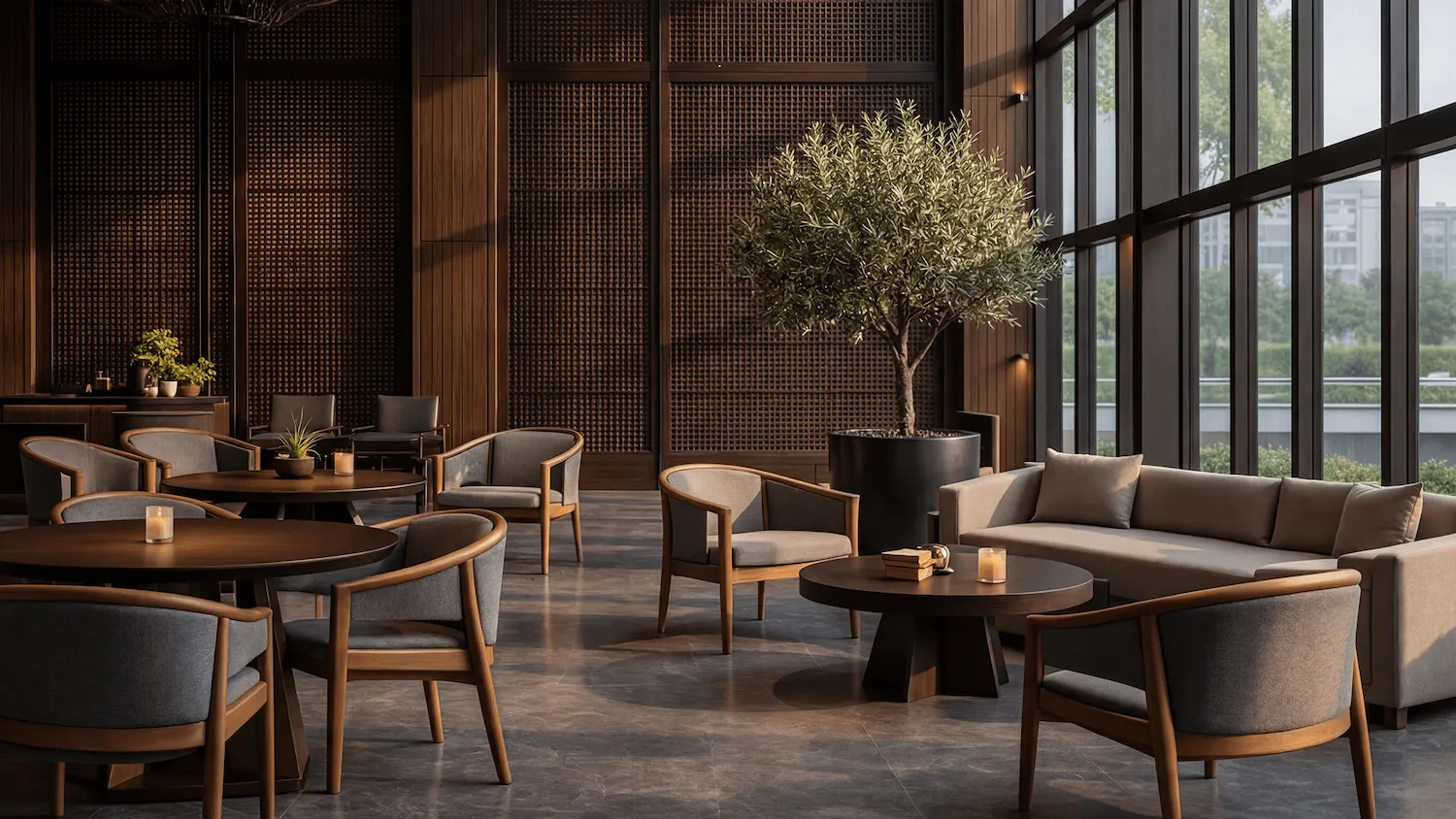
Every restaurant negotiates the same tension: more seats increase potential revenue per square foot, yet higher density can erode guest comfort and lengthen service times. In practice, the right equilibrium is shaped by concept, local code, and operational choreography. Dining rooms compete with circulation, queuing, accessibility-code clearances (e.g., ADA in the U.S.), acoustic treatments, host stand visibility, and the constant movement of staff. Decisions about tables, booths, and banquettes ripple through the entire guest journey – from how quickly a host can find a suitable seat to how confidently servers navigate a tight aisle without spillage.
Computer‑generated imagery lets teams evaluate that equilibrium before any fit‑out begins. By building a photorealistic, dimensionally accurate 3D model (a design-stage digital replica) of your interior, you can test multiple configurations of your restaurant seating layout with live operations in mind rather than guessing from a static drawing. Instead of debating abstractions, stakeholders stand inside the space virtually, see server paths, and experience clearances at the human scale of a chair pull‑back or a pram turning radius.
The financial logic is straightforward. Revisions on paper are cheap; revisions after millwork installation are not. CGI places the most consequential layout choices earlier in the timeline, where changes are fast, and costs are predictable. The result is better alignment across architects, interior designers, owners, and front‑of‑house leadership.
What CGI can test before you build
A robust visualization workflow does more than show finishes. It measures. GENENSE models geometry to a dimensionally reliable level based on the latest CAD/BIM and confirmed product dimensions, then adds workflow-based simulations to evaluate seating density and comfort. That includes:
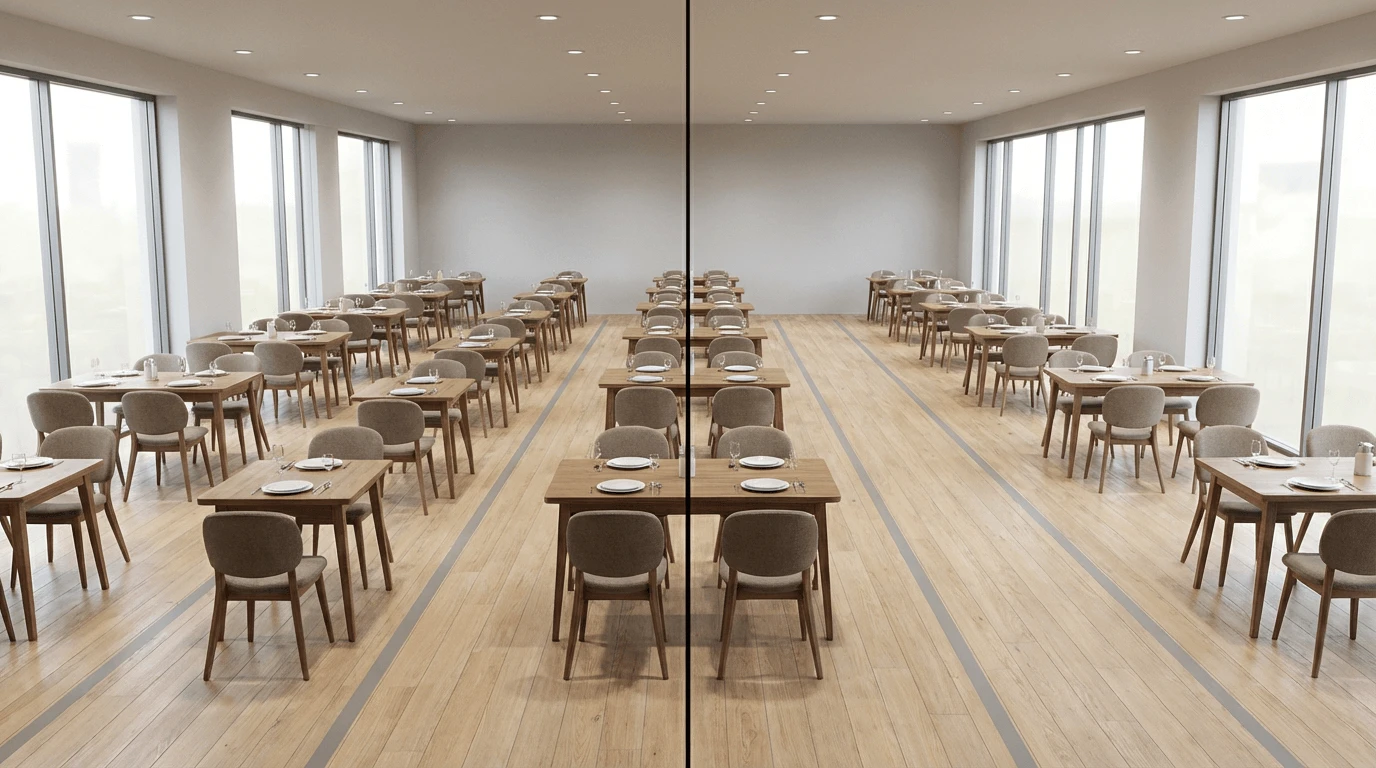
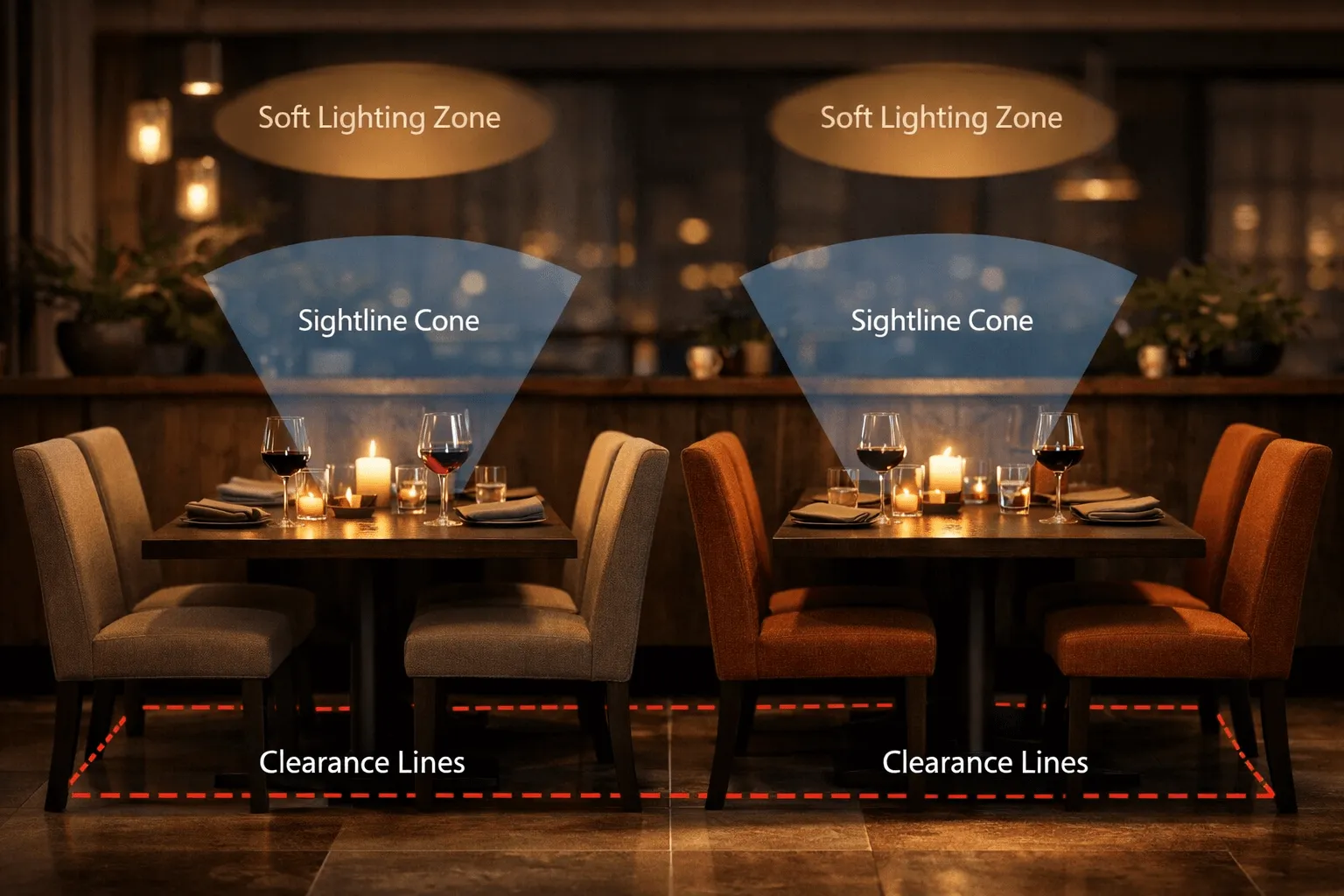
Table spacing and seat envelopes: chair pull-back, circulation clearance, and comfort-oriented ergonomic allowances (based on agreed project assumptions) across two-tops, four-tops, and banquette layouts.
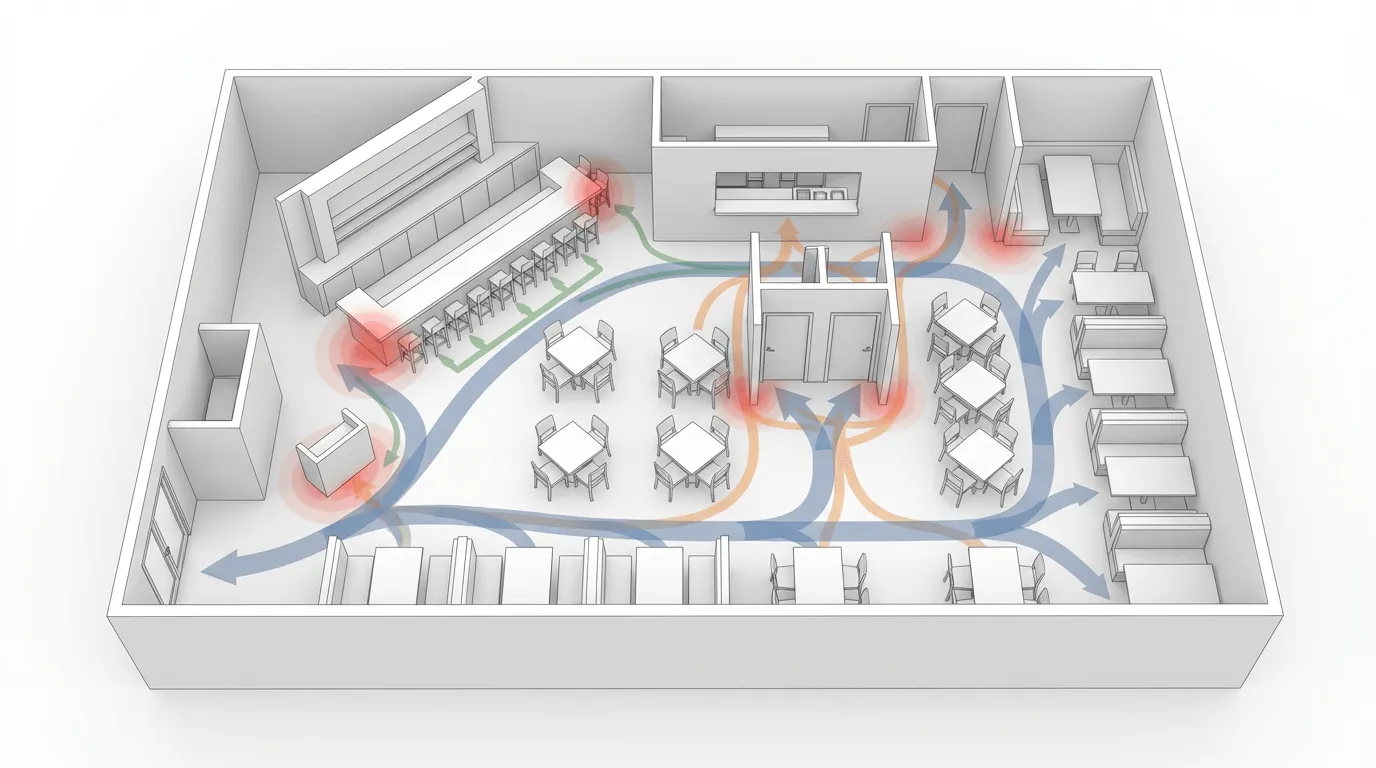
Circulation and service paths: staff routes, tray swing arcs, and cross‑traffic near the bar and pass.
Visibility and ambience: sightlines from entry to host stand, daylight penetration, focal walls, and privacy at corner banquettes.
Operational pinch points: POS terminals, bussing stations, restrooms, door swings, and queue overflow effects.
These checks make a conventional restaurant seating plan far more informative. Instead of a pleasant image next to a dimensioned drawing, you have a synchronized, testable model. We test circulation under peak conditions, detect clashes between furniture and joinery, and flag micro‑conflicts – the extra inch a chair needs to clear a column, or the wheelchair turning space required by the applicable accessibility standard (for example, a 60-inch turning circle or T-shaped turning space under ADA), without blocking the primary traffic flow.
For concept designers, this is particularly helpful during early restaurant seating layout design, when brand intent is still fluid. We can iterate quickly, capture the feel of different table mixes, and quantify the impact of swapping a row of two‑tops for larger round or square tables by the window.
From drawings to a measurable model
Most projects begin with architectural CAD or BIM plus brand guidelines. We import those files, clean geometry, and build a single source‑of‑truth interior model. Materials and lighting are calibrated to reflect real‑world behavior, so what you see feels credible under lunch and dinner scenes. At this stage, we align the model with your operational assumptions – turns per service, dwell time per party size, and target restaurant seating capacity – so our validations speak to business targets, not just code minima.
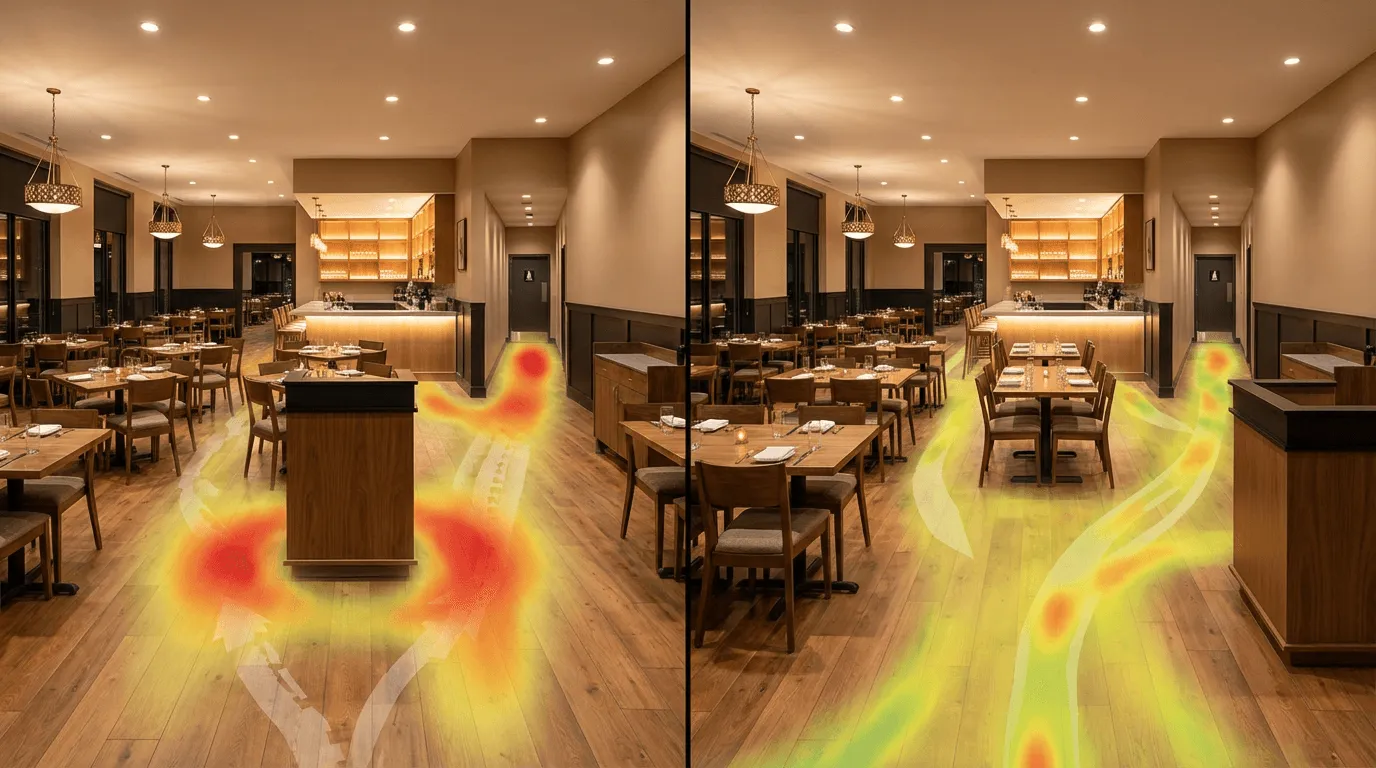
We then simulate circulation using parametric pathways and ergonomic envelopes. Chair pull‑back is tested at multiple table types, including square and round tops, and bench seating. Server traffic is plotted as heat maps to reveal congestion near bar pass‑throughs or kitchen doors. Aisle widths are tested against simultaneous bidirectional flow scenarios because one person passing is not the same as two servers crossing with trays.
The output is not just beautiful imagery. It includes annotated stills, short animations, and plans that highlight where comfort is compromised, where density can increase, and where the layout is already working well. For marketing teams, those same assets can evolve into launch visuals when the design is approved, avoiding duplicated effort.
Measuring comfort with metrics that matter
Comfort is not a single dimension. In a restaurant, comfort emerges from an interplay of physical spacing, sensory cues, and operational rhythm. CGI helps quantify and communicate several of these drivers:
Physical distance: We analyze the minimum clearance envelopes required for a guest to slide in and out without bumping the adjacent seat, including chair back interference at parallel tables. If a table is too tight, the model shows precisely how much to adjust.
Personal space perception: Privacy is influenced by sightlines and the angle of approach. Rendered vignettes and walk‑throughs reveal whether guests feel on display near the entrance or comfortably tucked into a quieter zone.
Acoustic impact: While full acoustic modeling may be outside the scope for early design, visual simulations of ceiling treatments, soft finishes, and partition height help flag qualitative acoustic risk in a high-density plan and inform whether a dedicated acoustic study is warranted.
Service flow: Traffic analyses expose points where a busy aisle intersects with guests standing to leave. Micro‑animations demonstrate those interactions so front‑of‑house staff can evaluate the choreography with their lived experience.
We present results visually and with clear annotations, so even non‑design stakeholders can grasp the implications quickly. The key is tying each observation back to the dual objective: maximize capacity without eroding the qualitative experience that drives return visits.
Transparent calculations for 3D seating capacity
The phrase may sound abstract, but 3D restaurant seating capacity is concrete in our workflow. Because the model is dimensional, we can count seats by type, calculate table‑mix ratios, and test incremental changes. Replace a pair of two‑tops with a six‑top and you immediately see the shift in party flexibility, server station balance, and throughput assumptions. Need to protect a specific aisle as an egress route or to maintain ADA compliance in a particular zone near the restrooms or bar entry? We lock those constraints and iterate the rest of the layout around them.
A typical deliverable set includes an operations‑ready diagram that tags each seat with identifiers, connects them to server stations, and lists turning distance requirements for chairs and service trolleys. For ownership groups balancing multiple venues, we can replicate the analysis across typologies – from compact urban cafés to 200‑seat brasseries – so decisions are consistent across the portfolio.
Integrating CGI into your project workflow
CGI should support, not disrupt, your design rhythm. Our process slots into standard architectural and branding milestones:
Discovery and data
We start with the program, target covers, brand mood, and dimensional constraints. If you already have restaurant floor plans, we align them with our modeling grid and verify critical dimensions such as column centers, bar length, and kitchen pass width. We also gather furniture specifications – seat height, chair width, and table bases – to model real products rather than generics.
Iteration and validation
We produce quick‑turn layout alternatives with annotated pros and cons. Each iteration is measured against capacity targets and comfort metrics. Because the model is consistent, comparisons are apples to apples – plan view changes map directly to the same camera angles in rendered views, so stakeholders are not misled by shifting perspectives.
Visualization for decisions and marketing
Once a preferred scheme emerges, we elevate fidelity. Materials, lighting, and brand details are tuned so the space feels authentic. This is where teams benefit from 3D restaurant rendering as both a decision tool and an early marketing asset. You can test finishes and ambience for design approval while preparing imagery for pre‑opening campaigns.
Practical inputs that make a seating study reliable
Not every project needs a highly complex simulation, but a few inputs dramatically improve the quality of results and keep revisions under control:
A current equipment and furniture schedule with confirmed dimensions and any non‑negotiable items, such as fixed banquettes.
Operational assumptions for peak periods – expected party size distribution, target turn times, and server station counts.
Any regulatory constraints or landlord requirements that shape capacity, including fixed egress widths, door swing rules, and any toilet-room location/travel limits under the applicable local code.
With these, the model becomes a decision engine rather than a mood board, capable of showing where space can be reclaimed and where constraints must remain inviolable.
Example scenario: reclaiming inches without sacrificing experience
Consider a 3,800 square foot corner bistro with a central bar, perimeter banquettes, and mixed two‑tops and four‑tops. The brief calls for warmth and buzz without crowding. Initial drawings achieve 118 seats, but the owner suspects a few more are possible.
We build the model, calibrate evening lighting, and run service flow animations. Heat maps show a congestion stripe where bar guests line up near the host stand, intersecting a primary service aisle. Shifting the host desk and rotating two square tables near the entry eases that pinch point. At the same time, chair pull‑back tests along the banquette reveal that moving table bases by a small distance improves ingress for larger parties without diminishing comfort at adjacent seats.
The end state is not a dramatic redesign. It is a series of minor, measurable moves – a 3 to 4 inch shift here, a rotated table there, a slight adjustment to the bar front – that accumulates into a few additional seats while maintaining generous sightlines and a more graceful service route. The team approves the revision sequence with confidence because they have seen it, measured it, and walked it virtually.
How CGI reduces risk and accelerates approvals
Planning boards and landlords often want to see the guest experience and circulation clarity, not just counts. Photorealistic restaurant environment visuals communicate that instantly. If an approval hinges on an egress path or how a queue will behave on a Friday night, we demonstrate it in context. For pre‑leasing and investor decks, this same visual language turns abstract occupancy assumptions into persuasive narratives backed by measurement.
As a practical matter, assets created for seating validation map directly to marketing deliverables. The lighting, material library, and camera compositions developed during validation become the backbone of the launch image set. That makes budgets work harder and shortens the time between design sign‑off and brand campaigns.
Request a quote
Implementation notes for design teams
To keep the pipeline clean, align early on model ownership and revision cadence. Pin down who updates the base architecture versus loose furniture, set naming conventions for stations and zones, and track each iteration’s seating count. It is also useful to codify target clearances for chair pull‑back and service aisle widths as project constants, so every option is judged against the same yardstick. If you are testing alternative furniture, update the geometry with true manufacturer dimensions rather than approximations – a subtle change in a chair arm profile can swing a clearance decision.
When the project moves from concept toward tender, the same model supports shop drawings, photomontage studies for signage, and 3D virtual tours to build sales momentum. Explore GENENSE’s interior visualization, architectural animation, and virtual tour services to extend the value of your seating study throughout the life of the project.
Closing thought
Balancing seat count with guest experience is not guesswork when you can measure, visualize, and iterate before you build. If you need to stress‑test your next dining room, talk to GENENSE about a focused CGI seating study. We will help you protect comfort, unlock hidden capacity, and arrive at a layout that serves both brand and operations.
FAQ
We simulate the dining room with accurate geometry and operational flows, then measure clearances, chair pull‑back, and server paths against your objectives. By comparing options in the same cameras and under the same lighting, you see precisely how density affects comfort and service rhythm. The process yields a documented count, annotated diagrams, and visual evidence that support design and investment decisions.
CGI is not a substitute for code interpretation or sign‑off, but it is a powerful way to visualize and measure the criteria your code consultant sets. If an egress path needs a specific width, or a turning circle must be preserved next to a service zone, we lock those constraints in the model and demonstrate compliance visually. This combination of annotation and photorealism often makes approvals smoother because reviewers understand the intent quickly.
We import your CAD or BIM files, keep model origins and layers consistent, and tag every seat for reliable counts. As layouts evolve, we update the visualization and the plan simultaneously so nothing drifts. The result is a live link between design development and visual communications – when the model changes, both plan and rendered evidence change together.
We do not replace your architect or interior designer, but we provide a measurable environment to test ideas rapidly. Early in concept design, we can assess multiple seating mixes, validate circulation and capacity, and produce views that help owners and marketing teams evaluate ambience. That collaboration turns a static drawing into a reliable decision platform.
Rate article:
Nice
Average rating: 5 / 5
Vote count: 2
Denys Borozenets
CEO at GENENSE
Denys is the CEO of GENENSE Studio. His mission is to build an international community of passionate CGI professionals, where everyone can unlock their potential by creating high-end digital content that helps highlight any product on the global stage.
As a leader, he holds himself to the highest standard of responsibility - for both his own work and that of his team. For the members of GENENSE, responsiveness and open communication are the core values that drive their collective success.
In today’s architecture RFP (Request For Proposal) market in the US, experience and portfolio alone do not win projects anymore. In 2026, 3D visualization plays a big role in how fast a committee understands, supports, and remembers a project. Florida’s procurement market moves fast and has its own rules. Teams often review many proposals in […]
In architectural tenders in the UK, competition is not about ideas, but about how clearly they are communicated. Success depends on a well-built architecture proposal presentation, and 3D visualisation often becomes the key factor that strengthens the evaluation of design quality. Architecture tenders in the UK are the main way to win large projects in […]
For developers and architects, 3D rendering services in the Netherlands create realistic images of real estate projects. It helps speed up approvals, present ideas better to investors, and support early-stage sales. It also reduces the number of revisions and makes cooperation between all project participants clearer. GENENSE provides 3D rendering for international projects, including work […]
3D kitchen rendering in the UK helps create a well-structured design environment for testing, refining and validating the design of a space before construction begins, being essential for architects, developers, manufacturers and interior designers. Professional rendering minimises the risk of uncertainties and additional costs caused by them through accurate visual simulation. In the UK context, […]
3D architectural visualisation in the UK is not a decorative add-on, but a functional decision-support tool for stakeholders in search of unique design solutions before construction begins. It collects drawings and BIM data to create a high-quality visual reference. 3d rendering services in the UK are essential for complex projects, which involve interaction of investors, […]
3D rendering services help check a project before it becomes expensive. They make it possible to fix architectural decisions, align them between all parties, and remove uncertainty at the planning stage, when changes do not affect the schedule or budget. For 3D architectural rendering in Costa Rica, strong visual accuracy is required. Projects often work […]